
 EN
Why breeding pairs are more sensitive to tank conditions than they look
Zebrafish are often described as hardy, and that reputation is mostly earned. Adults tolerate a wide range of conditions. Breeding pairs are a different story. Once a pair is set up for spawning, the fish are confined, often in a smaller volume, and exposed to each other without escape. Every change in water chemistry lands directly on them. Ammonia, nitrite, dissolved organic compounds, and shifting pH all add to the load. A pair that looks calm may still be mounting a physiological stress response that shows up later as fewer eggs, poorer embryo quality, or inconsistent spawning. The problem is not one dramatic event. It is the accumulation of small changes that manual water changes can introduce.
What automated water exchange actually changes
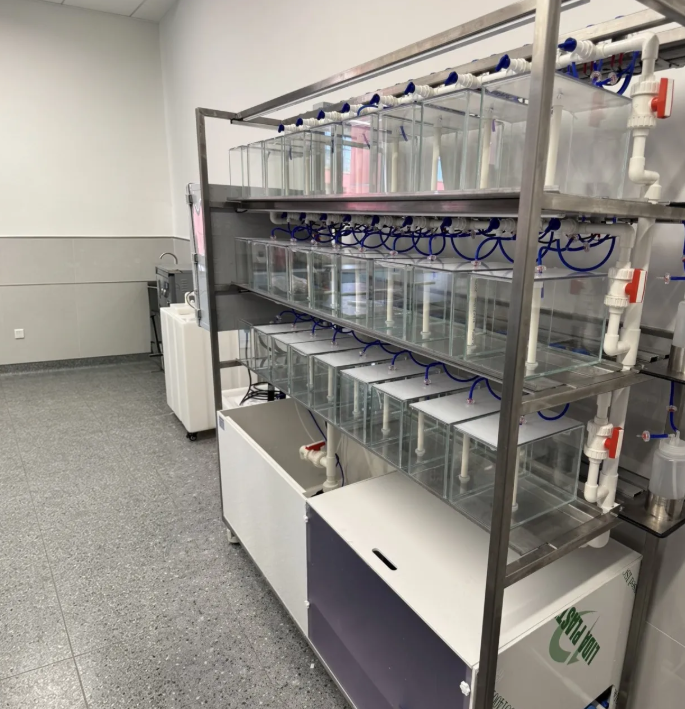
A zebrafish reproduction system with automated water exchange changes the baseline. Instead of a large manual change once a day or every few days, the system moves smaller volumes more often. That pattern keeps ammonia and nitrite closer to steady state. It also reduces the pH and temperature swings that come with dumping in a bucket of replacement water. The fish experience fewer abrupt transitions. There is also a human factor. Manual changes require opening the tank, moving lids, inserting a siphon, and sometimes chasing fish away from the intake. Each of those actions is a disturbance. Automated exchange removes most of them from the daily routine.
The stress pathways that stable water interrupts
Stress in fish is not just a feeling. It is a hormonal cascade. Cortisol rises, metabolism shifts, and energy that could go into gamete production gets redirected. Ammonia and nitrite are direct toxicants, but even sublethal levels can keep the stress axis activated. Dissolved organic matter from feed and waste can feed microbial blooms that consume oxygen and produce further irritants. Stable water exchange interrupts that loop. It also removes some of the chemical signals that accumulate in a closed volume. Breeding pairs communicate through pheromones, and those signals can become overwhelming in a small tank with limited turnover. Consistent exchange keeps the chemical environment closer to what the fish would experience in a flowing system.
| Condition | Manual water changes | Automated water exchange |
|---|---|---|
| Ammonia and nitrite | Larger swings between changes | Smaller, more frequent corrections |
| pH and temperature | Abrupt shifts during refill | Gradual, matched replacement |
| Human disturbance | Netting, siphoning, lid movement | Minimal daily contact |
| Dissolved organics | Accumulate between changes | Continuously diluted |
| Spawning consistency | Often variable | Usually more predictable |
A facility case where the plumbing change mattered more than the feed
A mid-sized facility had a set of breeding pairs that spawned well for a few weeks and then tapered off. Feed was changed first. Light cycle was checked. Health screening came back clean. The one variable that had not been touched was the water change routine. Manual changes were done in the morning, right before the spawning window. The team moved to a small-volume automated exchange that ran overnight. The replacement water was pre-tempered and degassed. Within a few weeks, the pairs were spawning more consistently. The egg counts were not dramatically higher every day, but the week-to-week pattern was steadier. The takeaway was not that automated exchange is a miracle. It was that timing and disturbance mattered as much as total water volume.
Design details that keep exchange gentle and predictable
Automated exchange only helps if the water going in and out is handled with care. A few details make a difference.
-
Match temperature and pH before the water reaches the tank.
-
Use a low-flow inlet that does not create a current strong enough to push breeding pairs around.
-
Screen the drain so eggs and larvae are not pulled out.
-
Pre-treat replacement water for chlorine and chloramine.
-
Add redundancy for overflow protection and pump failure.
-
Keep sensors calibrated and clean.
A system that exchanges too much water too fast can create its own stress. The goal is stability, not maximum turnover. A simple flow meter on the inlet gives a quick visual confirmation that the exchange is running as planned.
What automation cannot fix, and where judgment still matters
Automated water exchange is not a substitute for husbandry. It will not correct poor nutrition, overcrowding, disease, or a bad light cycle. It will not tell anyone that a pair is incompatible. It also adds equipment that needs maintenance. A clogged drain or a drifted sensor can create problems faster than a manual routine would. The most reliable setups combine automation with a daily visual check. Someone still needs to look at the fish, not just the data. When used within those limits, automated exchange removes a chronic stressor and gives breeding pairs a more stable environment. That stability is often what makes the difference between sporadic spawning and a dependable production curve.
Hunter Lab works on the manufacturing side of this equipment ecosystem. The company focuses on consistent fabrication, material selection, and supply chain reliability for lab-scale aquatic systems. For teams evaluating a zebrafish reproduction system with automated water exchange, that production discipline often determines whether the hardware stays stable over months of continuous operation.








