
 EN
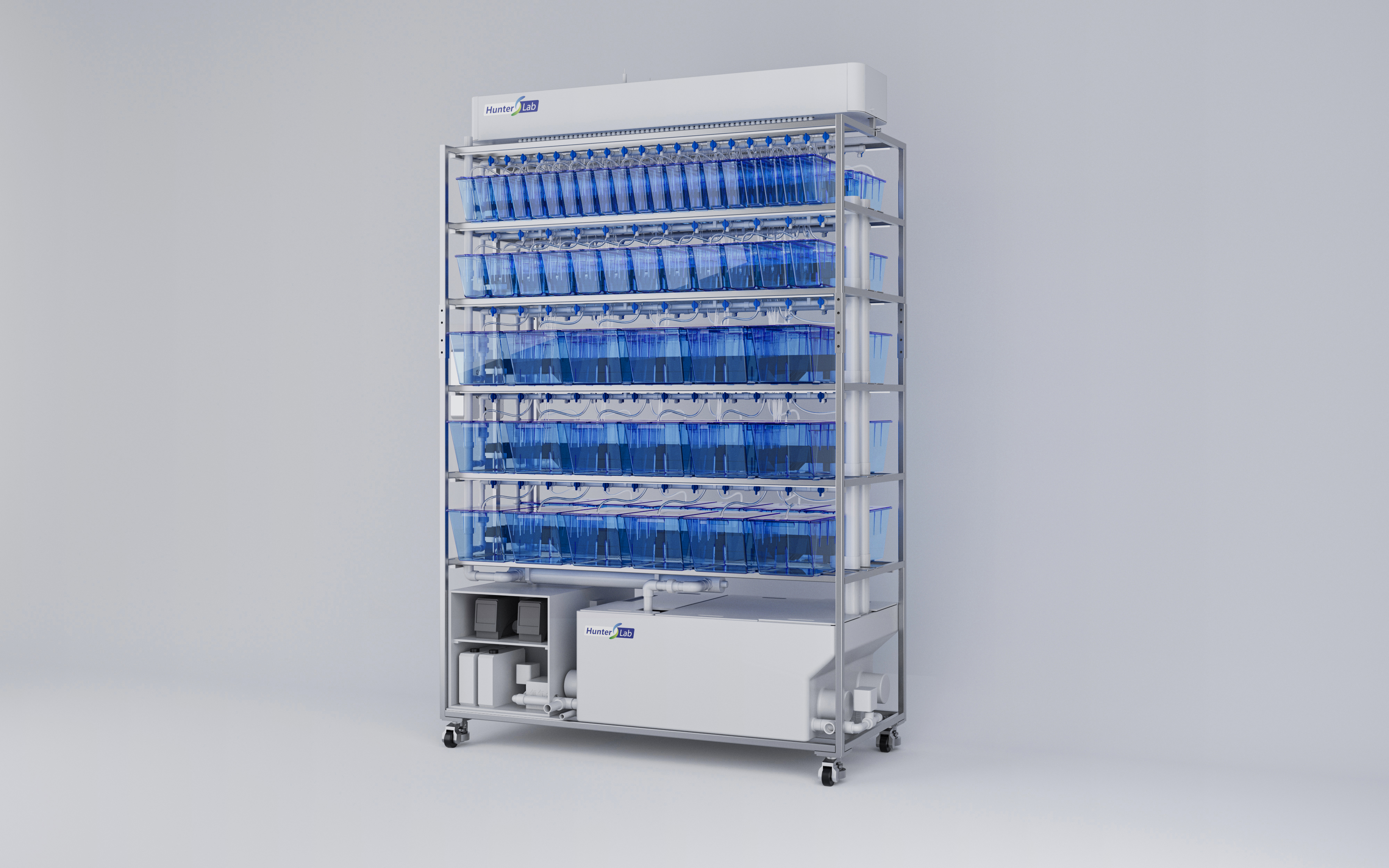
Why is flow-through exposure preferred in zebrafish toxicological studies?
In a Zebrafish Toxicological Exposure System, the important question is not whether flow-through is fashionable. It is whether the fish or embryos experience the concentration that the study design says they should experience. Flow-through exposure is often preferred when chemical loss, changing water quality, or a long study duration could make a static bath misleading. By continuously supplying conditioned test solution and removing spent water, it can reduce the gap between nominal concentration and real exposure.
That distinction matters in developmental and aquatic toxicology. A nominal dose is only the concentration prepared at the start. The biologically relevant dose is the concentration available to the organism over time. If a compound adsorbs to plastic, volatilizes, degrades, precipitates, or is diluted by an uncontrolled top-up, a well-labeled beaker can still deliver an unstable exposure.
The assumption to replace: a prepared dose is not automatically a stable dose
Static and semi-static designs remain useful for many short, well-characterized studies. They are simpler to run, use less test material, and can be appropriate when analytical checks show that exposure remains within the study’s acceptance limits. But “we prepared the same concentration in every vessel” is not evidence of stability. It only describes the initial condition.
A flow-through design changes the control point. Instead of relying on a single addition to carry the study, pumps or metering devices deliver fresh exposure medium at a defined rate while overflow or withdrawal removes used medium. The intent is to approach a steady, measurable concentration at the animal. That is particularly valuable for substances with difficult physicochemical behavior, or for studies in which waste, metabolites, feeding, and evaporation could otherwise alter the water matrix.
Why flow-through improves interpretability
1. It protects concentration stability over time
The clearest reason to choose flow-through is concentration control. When test solution is renewed continuously, losses from degradation or sorption can be offset by replenishment, provided the dosing system is properly characterized. This does not eliminate the need for chemistry. Investigators still need analytical measurements of exposure water, and they should sample at points that reveal whether the concentration is consistent across the system. What flow-through provides is a design better suited to maintaining stability rather than hoping a static concentration stays constant.
OECD Test Guideline 236 describes a 96-hour fish embryo acute toxicity exposure period and recognizes alternative systems such as flow-through or passive dosing. That is useful context, not a mandate: the appropriate design still depends on the chemical, life stage, endpoint, and study purpose.
2. It makes dose-response results more credible
Toxicological conclusions often depend on a gradient: lower concentrations should be distinguishable from higher concentrations, and replicate groups should receive comparable conditions. If the high concentration falls quickly while the low concentration remains near target, the apparent dose-response curve can flatten or shift for a reason unrelated to biology. A controlled Zebrafish Toxicological Exposure System helps investigators connect observed effects to measured exposure, which improves the accuracy of interpretation.
This is especially important when comparing subtle sublethal endpoints, such as behavior, morphology, cardiac function, or developmental timing. In those settings, unexplained concentration drift can look like biological variability. The question to ask is simple: can your exposure verification distinguish a real effect from a changing dose?
3. It reduces water-quality confounding in longer studies
For chronic or repeated-dose work, the water itself can become a confounder. Uneaten food, waste products, microbial growth, and shifting dissolved gases may change animal condition independently of the test article. A suitably designed flow-through setup can continuously refresh the medium and support more consistent environmental conditions. It is not a substitute for monitoring temperature, dissolved oxygen, pH, conductivity, and loading, but it gives those controls a more stable operating environment.
That point is easy to miss because a system can look clean while conditions drift. In practice, a written log of flow rates, reservoir preparation, calibration checks, and water-quality measurements is often more useful than a complex apparatus without traceable records.
Where flow-through is most likely to be preferred
- Volatile, unstable, hydrophobic, or sorptive substances: these chemicals may not remain at their nominal concentration in a static vessel.
- Longer exposures: as study duration increases, the opportunities for chemistry and water quality to change also increase.
- Endpoints sensitive to small exposure differences: subtle developmental, behavioral, or physiological outcomes demand greater confidence in delivered dose.
- Toxicokinetic or bioconcentration studies: consistent water concentrations make uptake and elimination patterns easier to interpret.
- Programs requiring strong traceability: a controlled system can make calibration, sampling, and deviation records easier to organize for review.
When static renewal may still be the better choice
Flow-through is not automatically preferred for every zebrafish study. It adds hardware, validation work, test-solution consumption, and operational failure points. For a stable compound in a short embryo assay, a carefully managed static-renewal design with measured concentrations may provide adequate control at lower complexity. The right choice depends heavily on demonstrated exposure behavior; a sophisticated system cannot compensate for poor mixing, pump drift, or inadequate analytical verification.
In other words, choose the design that can document the real exposure most convincingly. For some studies, that will be static renewal. For others, particularly when concentration loss is plausible, flow-through is the more defensible route.
A practical checklist for selecting a zebrafish exposure design
- Characterize the test article’s solubility, volatility, degradation, and adsorption risks before deciding on the exposure format.
- Define the time window and endpoint sensitivity: a 96-hour embryo study and a multiweek juvenile study do not carry the same control burden.
- Plan analytical sampling around the actual system, including reservoirs, representative chambers, and appropriate time points.
- Set acceptance criteria for concentration, flow rate, and water-quality parameters before the first biological run.
- Use controls and replicates that can reveal system-level variation, not only animal-to-animal variation.
- Document deviations. A failed pump, a changed stock solution, or a late sample is data-quality information, not something to hide in a final summary.
Conclusion
Flow-through exposure is preferred in many zebrafish toxicological studies because it can make delivered dose more stable, environmental conditions more consistent, and results easier to defend. Its value is not the equipment itself; it is the stronger link between the concentration intended, the concentration measured, and the biological response observed. When that link is at risk in a static design, a well-validated flow-through Zebrafish Toxicological Exposure System is often the more accurate choice.








