
 EN
Why Is a Zebrafish Behavioral Analysis System With Automated Tracking More Reliable Than Manual Scoring?
In zebrafish behavior work, the difficult question is rarely whether an animal moved. It is whether the movement was measured the same way across wells, days, operators, and experimental groups. A Zebrafish Behavioral Analysis System with automated tracking is generally more reliable than manual scoring because it turns video into predefined, repeatable measurements rather than relying on a person to notice, interpret, and record each event in real time.
That does not mean software makes an assay valid by itself. Lighting, camera position, animal density, acclimation, and tracking settings still matter. The practical advantage is that a well-configured Zebrafish Behavioral Analysis System makes those choices explicit, preserves the underlying recording, and applies the same calculation to every comparable subject.
Manual scoring introduces variability before analysis even begins
Manual scoring can be useful for exploratory work or behaviors that a system cannot yet classify well. But it asks an observer to manage several tasks at once: watch the fish, decide whether a movement meets an ethogram definition, time it, record it, and remain consistent over a long session. Small differences in attention, fatigue, screen position, or interpretation can change the result.
Consider a simple activity assay. One scorer may count a brief burst only after a visible acceleration; another may include a shorter movement. If the observation window starts a few seconds late, the recorded bout count can change again. These are not necessarily mistakes. They are examples of how a human measurement process can vary unless definitions, training, blinding, and reliability checks are tightly controlled.
Manual scoring also compresses behavior into selected observations. It may capture “active” versus “inactive” or a count of crossings, but it is harder to retain the full path, instantaneous speed, position over time, and exact timing of a response. That lost resolution limits later review when a result needs to be checked.
Automated tracking fixes the measurement rule before samples are compared
With automated tracking, the study team defines acquisition conditions and endpoint rules up front. A video-based workflow typically moves from image acquisition to tracking and then to endpoint extraction. Once the rule set is locked, every qualifying video is processed using the same thresholds, spatial zones, and time windows.
This is the core reliability benefit of a Zebrafish Behavioral Analysis System. It does not “see better” in every circumstance; it calculates more consistently when the inputs and settings are controlled. Distance traveled, velocity, time spent in a zone, turn angle, freezing duration, and movement bouts can be derived from the same coordinate stream instead of being reconstructed from notes.
- Consistent timing: each animal can be evaluated over the same defined baseline and stimulus intervals.
- Consistent thresholds: the minimum movement, zone boundary, or event duration is applied identically.
- Traceable output: teams can retain videos, tracks, exclusion rules, and exported endpoint tables for review.
- Reduced observer influence: blinded analysis becomes easier because the calculation does not depend on a scorer recognizing treatment groups during the run.
Why continuous data improves reliability, not just throughput
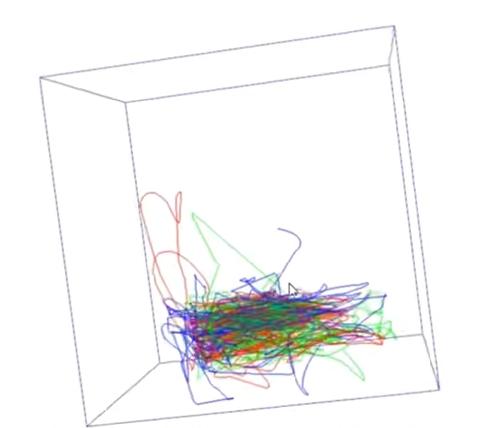
The value of automation is not limited to processing more samples. A Zebrafish Behavioral Analysis System can preserve a continuous trajectory rather than a few manually marked moments. That makes it possible to revisit an apparent group difference: Was it sustained locomotor suppression, a short response to a stimulus, edge preference, or a tracking artifact near a reflection?
Continuous records also support more disciplined quality control. A team can inspect overlay videos, flag occlusions, verify that the arena was detected correctly, and document exclusions before statistical analysis. In contrast, a manual scoring spreadsheet often shows the final count without a direct route back to the exact event that produced it.
For this reason, reliability should be understood as auditability as well as repeatability. When the original video, protocol settings, and output table travel together, another trained user has a clearer route to reproduce the measurement process.
Where manual scoring still has a role
Automated analysis should not be treated as a substitute for experimental judgment. Novel social interactions, abnormal postures, and behaviors obscured by overlap or poor contrast may require human review. The strongest workflow often uses manual observation as a validation layer: define a representative set of videos, score it using a written rubric, compare those labels with the automated endpoints, and investigate meaningful disagreements.
This approach avoids a false choice. Automated tracking provides a repeatable primary measurement pipeline, while expert review tests whether the system is measuring the biological behavior the assay intends to capture. The same review process should be repeated after changes to camera hardware, fish age, arena geometry, or illumination.
A practical validation checklist for consistent results
Before relying on a Zebrafish Behavioral Analysis System for a screening or comparative study, document the conditions that make automated measurements defensible:
- Write operational definitions for every endpoint, including time windows and exclusion criteria.
- Standardize camera angle, frame rate, contrast, background, water depth, and arena layout.
- Run representative videos with track overlays to check identity swaps, missed fish, reflections, and boundary errors.
- Use blinded file names and preserve raw video alongside exported results.
- Compare a planned sample of automated outputs with independent manual scoring during method setup.
- Record software version, thresholds, and any adjustments so future runs use the same analysis recipe.
These controls improve consistency whether a laboratory uses one tank or a multi-arena workflow. They also make it easier to explain why a result is trustworthy when collaborators ask how a behavioral endpoint was calculated.
The practical conclusion
A Zebrafish Behavioral Analysis System with automated tracking is more reliable than manual scoring when it is configured and validated for the assay because it applies fixed measurement rules, creates reviewable records, and captures behavior as time-resolved data. Manual observation remains valuable for validation and complex behaviors, but it is less suited to serving as the only measurement engine when repeatability across observers and experiments matters.
For laboratories planning a standardized workflow, Hunter Lab’s zebrafish research equipment site provides the relevant organizational context; any system decision should still be matched to the assay design, species life stage, and validation plan.








