
 EN
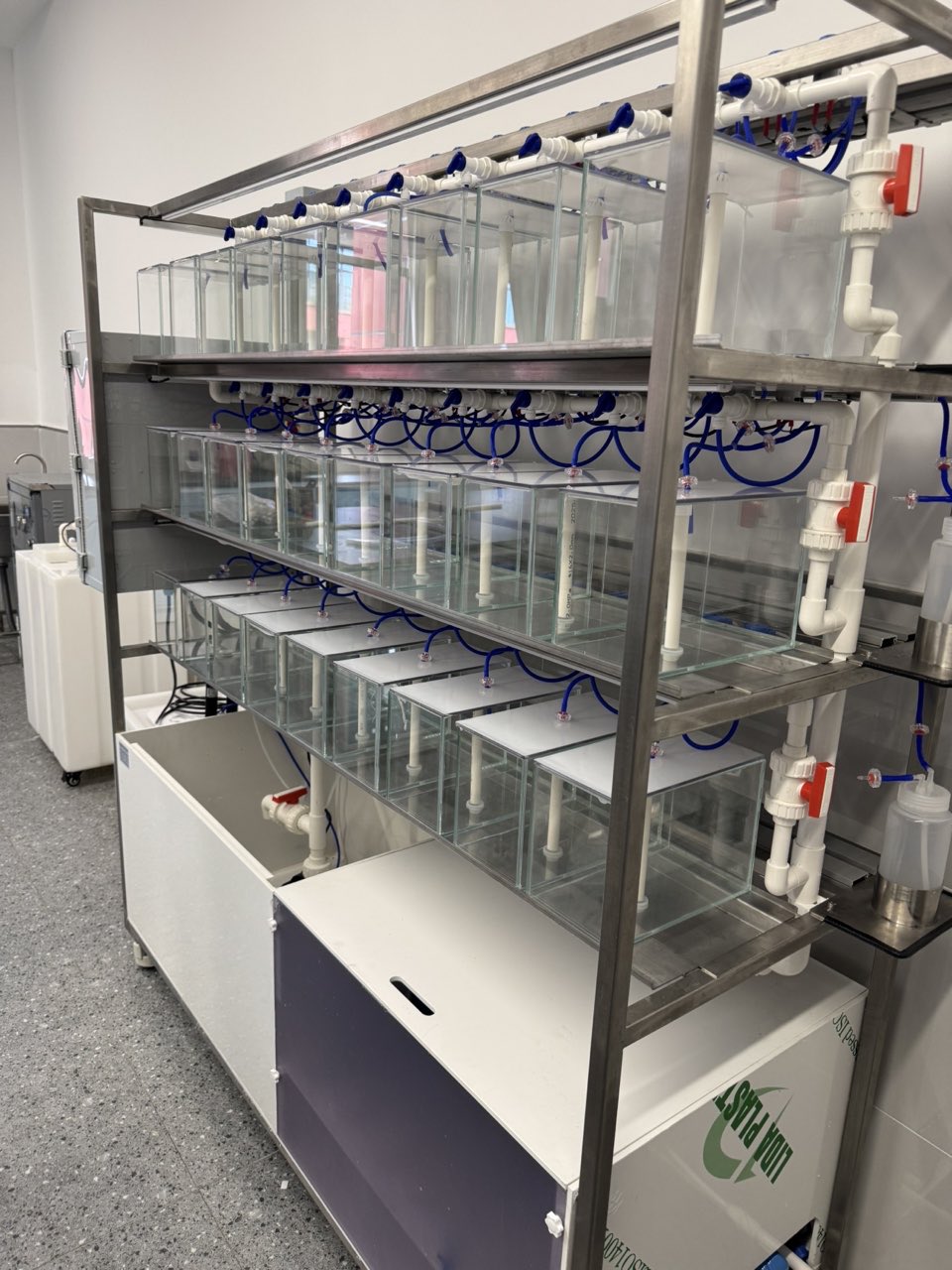
What is the chemical compatibility of a zebrafish toxicological exposure system?
A Zebrafish Toxicological Exposure System is chemically compatible only when its wetted materials preserve both the equipment and the intended exposure. That definition goes beyond asking whether a tank, plate, pump, or fitting will visibly corrode. In a zebrafish assay, a component may remain intact while still changing the study by adsorbing a test article, releasing extractables, or making a nominal concentration difficult to maintain.
For pharmaceutical and chemical-safety teams, the useful question is: can the complete exposure path deliver the intended aqueous environment for the specific formulation and test duration? The answer depends on the chemical, solvent or vehicle, temperature, renewal mode, and every material that contacts the dosing solution.
Chemical compatibility has two parts
First, the material must tolerate the exposure medium. Swelling, crazing, discoloration, cracking, softening, seal damage, and metal attack are warning signs that a component may not remain serviceable. Second, the system must be analytically compatible: it should not meaningfully remove the test article from solution or add substances that confound a biological endpoint.
The two checks are related, but they are not interchangeable. A polymer can show good physical durability in dilute buffer yet bind a hydrophobic analyte. Likewise, a metal support can resist routine water exposure but become a corrosion concern where the formulation, pH adjustment, salts, or cleaning chemistry creates a more aggressive local condition. Evaluate the full contact path, including reservoirs, test chambers, tubing, connectors, seals, pumps, sampling devices, and drain lines.
Why this matters in a Zebrafish Toxicological Exposure System
Zebrafish embryo and larval studies often use static, semi-static, flow-through, or passive-dosing approaches. Each configuration changes residence time, surface-area-to-volume ratio, and the number of material interfaces. In a small-volume study, even a short run of tubing or a poorly matched seal can matter more than it would in a larger process vessel.
OECD Test Guideline 236 illustrates the principle rather than supplying a universal compatibility chart. It describes chemically inert test tanks, with glass as an example, and notes that glass or polystyrene chambers may be used. For substances with high hydrophobicity, the guideline specifically highlights inert glass to reduce loss through adsorption. That does not make glass automatically correct for every compound or workflow; it does show why exposure-system chemical compatibility must be considered alongside biological protocol design.
A practical material decision framework
1. Start with the exposure chemistry, not the equipment catalog
Document the test article, concentration range, solvent or dispersant, expected pH, ionic strength, temperature, and contact time. Include stock-solution preparation and cleaning agents. A component suitable for an aqueous embryo medium may be unsuitable for a concentrated stock or an organic co-solvent used upstream. If the formulation is proprietary or complex, obtain compatibility guidance from the material supplier and verify it under representative conditions.
2. Separate wetted materials from external hardware
List every wetted material by its actual grade where possible: chamber, reservoir, tubing, gasket, adhesive, coating, probe housing, and metal fitting. External frames and electronics still need durability assessment, but they do not create the same exposure-integrity risk as parts touching the solution. This separation makes it easier to prioritize review and change control.
3. Look for three failure mechanisms
- Physical degradation: swelling, brittleness, seal failure, deformation, or visible corrosion.
- Analyte loss: adsorption, absorption, precipitation on a surface, or interaction with a coating.
- Contamination: leachables, residues from cleaning, lubricants, degraded plasticizers, or carryover from a prior test.
That third mechanism is easy to miss during setup. A system can appear clean and mechanically sound while a residue shifts a sensitive developmental or behavioral endpoint. For that reason, cleaning validation and blank controls are part of compatibility work, not an afterthought.
How to assess corrosion and durability without overclaiming
Do not assign a universal “compatible” label to a Zebrafish Toxicological Exposure System. Instead, define the intended operating envelope and test it. For metals, inspect the relevant alloy, welds, fasteners, and crevices; galvanic pairs and stagnant zones can behave differently from broad exposed surfaces. For polymers and elastomers, record the resin or elastomer grade because trade names alone are rarely enough for a defensible decision.
Run a controlled pre-study exposure with the actual medium whenever the chemical class, vehicle, or duration raises doubt. Compare mass balance or measured concentration at preparation and at relevant time points, then inspect contact parts after exposure. Add blanks that follow the same contact path. This approach turns “durability” from a catalog assumption into a study-specific control.
Special considerations for low-solubility and hydrophobic chemicals
Low-solubility compounds deserve extra caution because dissolved concentration can be affected by vessel walls, tubing, bubbles, mixing, and renewal procedures. Higher surface area relative to volume increases the opportunity for material interaction. Minimize unnecessary wetted area, use a consistent chamber and sampling workflow, and avoid changing contact materials mid-study without documenting the effect.
Passive dosing or flow-through designs may help certain exposure questions, but they also add materials and interfaces that need separate review. Choose the configuration that maintains a verified exposure profile for the compound and endpoint, rather than the one with the most hardware.
A pre-study checklist
- Map the entire wetted path and identify the precise material of each contact component.
- Define the test article, vehicle, concentration range, pH, temperature, and maximum contact duration.
- Review supplier compatibility information for the actual material grade and chemical conditions.
- Perform representative soak, visual-inspection, and exposure-concentration checks when uncertainty remains.
- Use blanks, replicate sampling, and documented cleaning procedures to detect contamination or carryover.
- Set acceptance criteria for concentration stability, visible degradation, leakage, and unexpected background effects before the study begins.
The bottom line
The chemical compatibility of a Zebrafish Toxicological Exposure System is not a single property of “plastic versus metal.” It is the demonstrated fit between the test chemistry, the wetted material set, and the planned exposure design. Prioritizing adsorption control, corrosion assessment, cleanliness, and verified durability helps protect both the equipment and the credibility of the toxicology result. When the compound or vehicle is unfamiliar, a small compatibility study before the biological run is usually more informative than relying on a generic material claim.








