
 EN
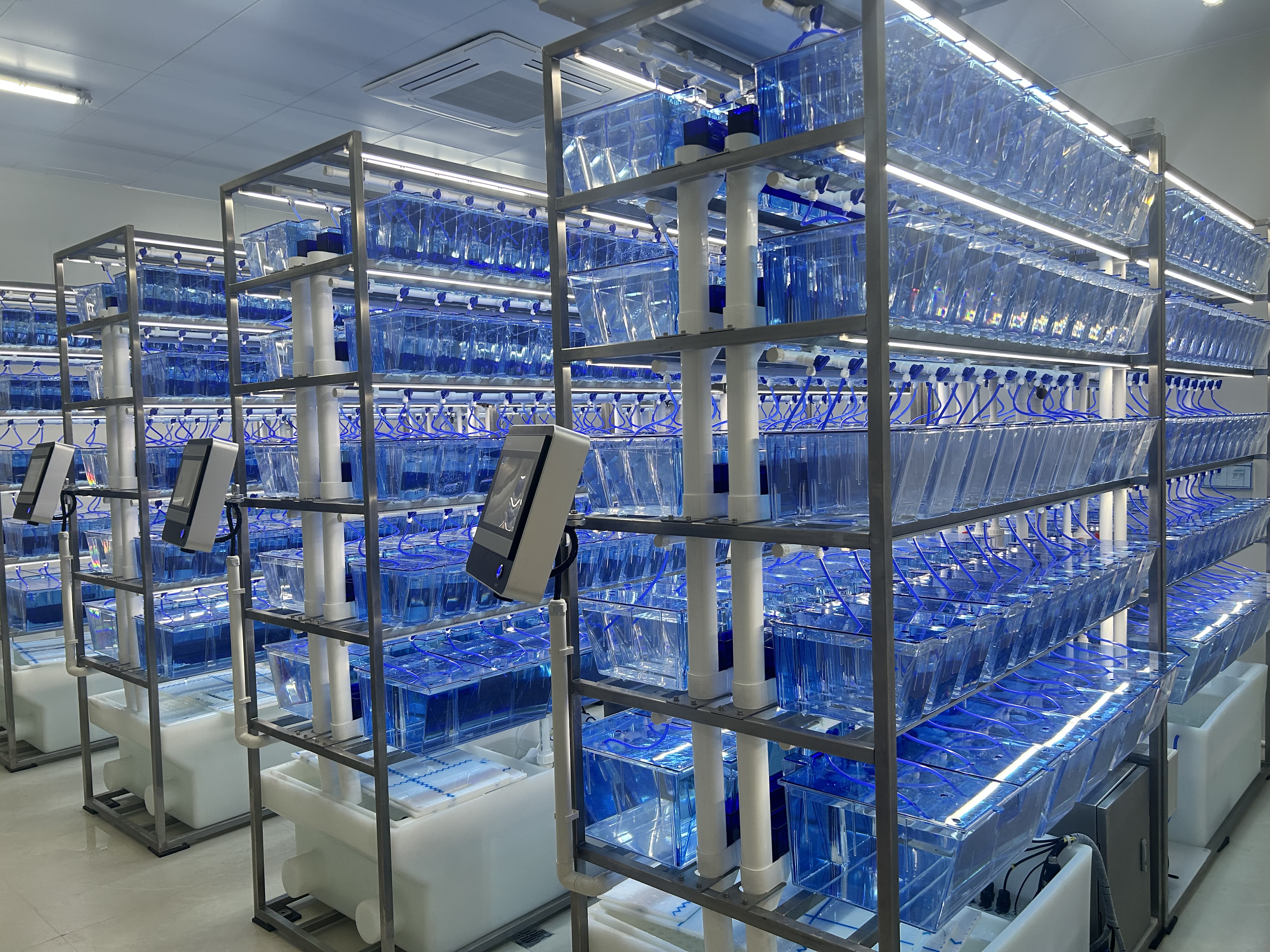
A Zebrafish Automated Feeding System can turn a fixed feeding timetable into a repeatable husbandry process. Its value is not simply that food arrives without a person at every rack. The useful part is control: staff can set feeding frequency, document the intended program, review whether it fits each life stage, and adjust it when fish condition or water-quality observations say the program needs attention.
For research colonies, feeding is part of experimental control. Small differences in timing, portioning, or the consistency of delivery can affect growth, cohort uniformity, breeding condition, and the interpretation of study outcomes. A 2024 review of zebrafish feed intake also underscores why a single setting is not appropriate across a facility: suggested daily feeding rates differ among larvae, juveniles, and adults. A schedule therefore needs local validation rather than a copied setting.
What feeding frequency optimization means in practice
Feeding frequency optimization is the process of matching how often food is delivered with the group’s stage, density, feed type, tank conditions, and observed consumption. A Zebrafish Automated Feeding System provides the repeatable timing needed to test that match. It does not decide a biological target on its own; facility staff still set the program and judge its outcomes.
Instead of relying on an informal routine such as “feed whenever the room is staffed,” a team can define separate programs for larval, juvenile, adult, breeding, quarantine, or protocol-specific groups. That makes the schedule reviewable. If a cohort is growing unevenly, the question becomes concrete: was feeding frequency, ration size, feed particle size, or tank competition the likely contributor?
Why frequency is only one control variable
More frequent delivery is not automatically a better choice. The daily ration is divided across events, so increasing the number of events without reconsidering the portion can add excess feed. Uneaten feed can increase the organic load in a system and is a reason to include leftover observations and water-quality checks in the review routine.
We find it helps to separate three decisions:
- Daily feed allowance: the total amount intended for the group over a day.
- Feeding frequency: the number and timing of delivery events that distribute that allowance.
- Verification criteria: what staff will inspect after delivery, such as visible leftovers, fish condition, behavioral response, and relevant water-quality records.
That distinction matters because a frequent schedule with small, accepted portions may behave differently from a small number of large deliveries, even when the nominal daily allowance is similar. Actually, the appropriate comparison depends on the facility’s feed, strain, developmental stage, and system conditions, so a local baseline should come before a broad schedule change.
How an automated program supports a structured trial
A practical optimization trial begins with a stable baseline. Keep the feed formulation, stock density, lighting routine, and other major husbandry conditions as consistent as possible while changing one schedule parameter at a time. This does not turn an automated feeder into a substitute for husbandry expertise; it makes the planned change easier to repeat.
- Define the group. Record life stage, tank count, density, feed type, and the outcome that matters most, such as stable growth, breeding readiness, or a manageable husbandry workload.
- Set a starting program. Divide the established daily allowance into a defensible number of feeding events. Use published ranges only as context, not as a universal prescription.
- Run the schedule consistently. Use the same programmed timing long enough to observe a pattern rather than reacting to one unusual day.
- Review consumption and conditions. Check whether food remains after an appropriate observation period and compare the results with routine water-quality and health observations.
- Change one parameter. Modify frequency or portion allocation, document the change, then reassess against the same criteria.
This approach also supports clearer handoffs. When different staff members cover weekends or multiple rooms, the programmed schedule and log provide a shared reference rather than a memory-dependent routine.
Signals that a schedule needs adjustment
A feeding program should be reviewed when routine observations show a repeated signal, not merely because an automated schedule is available. Examples include persistent leftovers, inconsistent body condition within a cohort, unexpected competition at feeding time, changes in breeding performance, or trends in water-quality records that align with feed delivery.
Manual observation remains important when a group is small, newly established, or biologically variable. Automation earns its role when repeatable delivery and documentation reduce avoidable schedule variation—but the transition still requires a validation run under the facility’s own conditions. If a tank or cohort behaves differently, pause the automatic assumption and examine the local cause.
What to ask when evaluating a Zebrafish Automated Feeding System
The relevant question is not simply whether a system can dispense feed. Ask whether the workflow supports measured refinement of feeding frequency:
- Can staff create distinct schedules for different husbandry groups?
- Can the team document program changes and connect them to observation logs?
- Does the delivery method suit the selected feed format and the facility’s cleaning routine?
- Can staff inspect delivery, detect blockages or humidity-related handling issues, and act on exceptions?
- Can the schedule be reviewed alongside density, growth, health, and water-quality observations?
These questions place the equipment within a husbandry system instead of treating it as a stand-alone answer. Hunter Lab focuses on zebrafish instruments and applications, and a pre-purchase discussion can be useful when a facility needs to align a feeding workflow with its research design and operating conditions.
Build a feedback loop, not a fixed promise
The central optimization benefit of a Zebrafish Automated Feeding System is repeatable timing that makes review possible. It can help a team distribute daily feed through a defined schedule, compare schedules fairly, reduce dependence on individual timing habits, and preserve a clearer record of what changed. Growth and yield are outcomes to monitor, not results that any single frequency can promise.
Start with a documented baseline, set stage-appropriate review criteria, and make small, traceable changes. That turns feeding frequency from a background chore into a controlled part of zebrafish colony management and experimental planning.








