
 EN
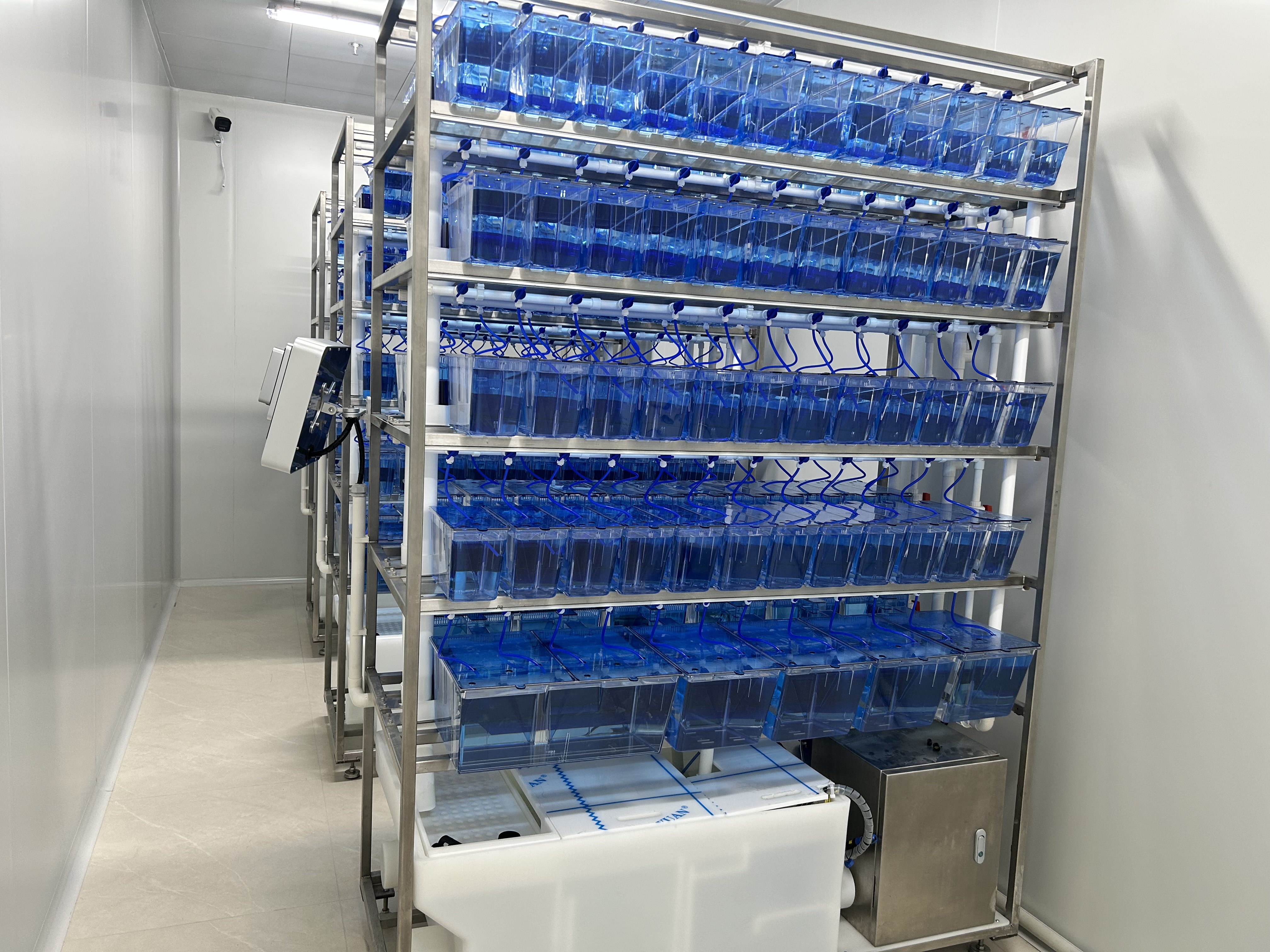
High density changes the rules of rack design
High-density housing sounds like a simple math problem. Fit more tanks into the same footprint, and the facility gets more capacity. In practice, density changes the biology of the system. More fish produce more waste. More waste consumes more oxygen and releases more ammonia. Pathogens spread faster through shared water. A rack designed for low density may hold the extra tanks, but it will not hold the water quality that those tanks require.
A zebrafish rack built for high-density housing has to start from water chemistry and animal welfare, not from shelf count. The design has to account for peak load, not average load. It has to make maintenance easy, because high-density systems punish neglect quickly. And it has to give staff a clear view of what is happening inside every tank.
Water flow and filtration capacity sized for peak load
Water flow is the first feature that separates a high-density rack from a standard one. Every tank needs a consistent exchange of water. Dead zones allow waste to accumulate, and fish in those zones experience poor conditions even when the sump looks normal. Manifold design, valve placement, and return line sizing all determine whether flow is uniform across the rack.
Filtration has to be sized for the peak, not the average. In a high-density system, feeding time and morning activity produce bursts of waste. Mechanical filtration captures solids before they break down. Biological filtration converts ammonia and nitrite into less harmful compounds. UV disinfection reduces the microbial load that can spread between tanks. A rack that supports high density should make all three stages accessible for cleaning and replacement.
-
Mechanical filtration with easy access to filter pads or socks.
-
Biological filtration with enough surface area for the stocked biomass.
-
UV disinfection sized to the flow rate of the system.
-
Flow indicators or sensors on each rack section.
Monitoring and alarm systems that catch problems early
In a low-density system, a water quality problem may take hours to become dangerous. In a high-density system, it can become dangerous in minutes. Oxygen can drop quickly when many fish are respiring in a small volume. Temperature can rise if flow stops through a heater. Ammonia can spike after a feeding event if filtration is undersized.
A high-density rack should include continuous monitoring for temperature, dissolved oxygen, pH, conductivity, and water level. Flow sensors are also valuable, because a blocked line can starve a whole section of the rack. Alarms should be tiered, with a low-level notification for investigation and a high-level alert for immediate response. Remote notification matters because problems often appear at night or on weekends.
| Feature | Standard rack | High-density rack |
|---|---|---|
| Water flow | Adequate for low biomass | Uniform, monitored, peak sized |
| Filtration | Basic mechanical and biological | Mechanical, biological, UV, accessible |
| Monitoring | Periodic manual checks | Continuous sensors with alarms |
| Access | Simple shelving | Ergonomic, tool free tank removal |
| Biosecurity | Basic cleaning routine | Separate quarantine, easy disinfection |
Ergonomics and access for daily care
High density increases the number of daily tasks. More tanks mean more feeding, more health checks, and more cleaning. A rack that is hard to work in will slow every one of those tasks. Over a year, that lost time adds up.
Access features that matter include adjustable shelf heights, front opening doors or removable panels, and drip trays that contain splashes. Tank removal should be possible without disconnecting plumbing or moving other tanks. Lighting should be reachable for replacement, and filters should be reachable for cleaning. A high-density rack that ignores ergonomics may hold more fish, but it will also generate more staff fatigue and more mistakes.
Environmental control and biosecurity features
High density puts more animals in the same air space, which makes environmental control more important. Temperature stability across every tier prevents hot and cool zones. Even lighting supports consistent behavior and reproduction. Ventilation removes humidity and carbon dioxide that can build up in a crowded room.
Biosecurity features are also part of the rack design. Smooth, inert materials resist biofilm and make disinfection easier. Separate quarantine racks or sections reduce the chance that a new arrival infects the main colony. UV disinfection on the return line adds a layer of protection. None of these features eliminate risk, but together they reduce the chance that a single problem becomes a facility-wide event.
A field example from a facility that scaled up density
A research facility in eastern China decided to increase its zebrafish capacity by adding more tanks to existing racks. The initial change was mostly mechanical. More tanks were hung on the same frames, and the same filtration system was expected to handle the load. Within a few weeks, water quality became unstable. Oxygen levels dropped in the evening, and ammonia readings rose after feeding.
The facility paused further expansion and reviewed the design. The team upgraded mechanical filtration, added a UV unit sized to the new flow, and installed continuous dissolved oxygen and temperature monitoring. Flow was rebalanced across the rack so that every tier received similar exchange. The number of tanks was not reduced, but the supporting systems were rebuilt to match the higher density. Water quality stabilized, and mortality returned to baseline.
That experience shaped how the facility plans new racks. Density is now treated as a system property, not a shelf count. The rack, the filtration, the monitoring, and the maintenance routine are designed together.
Hunter Lab (Hunter) builds zebrafish laboratory equipment with attention to the system level details that high-density housing requires. The manufacturing and quality control side supports the consistency that long-term colony management demands. For facilities planning a high-density rack, that kind of build discipline is part of the foundation.








