
 EN
What Capacity Options Are Available for a Zebrafish Incubator?
A zebrafish incubator is not selected by liters alone. For a small embryo workflow, a compact chamber may be enough; for a shared screening facility, the better choice may be a larger cabinet or several modular units. The useful question is how many plates, dishes, flasks, or breeding-derived embryo batches the incubator can hold at the same controlled conditions, with room for peak days and routine cleaning.
As a core-facility manager, I would start with workflow rather than a catalog dimension. Capacity should support the number of experiments that must run at once, the vessel format, the need to separate studies, and the next stage of growth. That approach makes a zebrafish incubator easier to size without assuming that one chamber volume fits every laboratory.
Capacity Comes in More Than One Form
When laboratories compare a zebrafish incubator, “capacity” can mean at least four different things. A vendor may list internal volume in liters, while the people using the chamber care more about shelf area and the number of containers that can be positioned without blocking airflow. Purchasing teams also need to consider electrical space, bench or floor footprint, and whether another unit can be added later.
- Chamber volume: the internal space stated in liters or cubic feet.
- Usable shelf capacity: the practical number of vessels that fit with stable air circulation and safe access.
- Batch capacity: the number of independent embryo or larval runs that can be held during the same time window.
- Growth capacity: the ability to add modules or replicate a validated setup as demand increases.
These measures are related, but they are not interchangeable. A chamber with generous stated volume can become awkward if shelves do not suit the vessel footprint, if containers are stacked too closely, or if users need to open the door repeatedly to reach a single batch.
Common Zebrafish Incubator Capacity Options
Compact or benchtop capacity
Compact units suit pilot work, small academic groups, or dedicated assays with a limited number of dishes or microplates. They can also help a larger facility isolate a temperature-sensitive run from the main workflow. This size class is practical when daily throughput is predictable and one operator can load, inspect, and remove vessels without creating a queue. The trade-off is limited contingency space when several crosses produce embryos on the same day.
Medium cabinet capacity
A medium cabinet-style zebrafish incubator is often the middle ground for teams handling several experiments in parallel. Adjustable shelving matters here because capacity changes with the mix of Petri dishes, multiwell plates, bottles, and covered trays. A 100-liter Peltier-based chilling and heating incubator has been described for zebrafish eggs and larvae, illustrating that a mid-sized controlled chamber can serve this application. That is a reference point, not a universal requirement: usable capacity still depends on the shelf layout, vessel dimensions, and the operating conditions specified for that unit.
Large cabinet or walk-in environmental capacity
Large chambers are relevant when a program runs many synchronized developmental studies, maintains multiple temperature conditions, or supports several investigator groups. The benefit is consolidated capacity; the operational challenge is that a door opening, a loading pattern, or a maintenance interruption can affect more work at once. Before choosing this route, define access rules, labeling, sanitation responsibilities, and a backup plan. Large capacity is valuable only when the workflow can protect each study within the shared space.
Modular capacity
Modular capacity means using several matching chambers rather than depending on one oversized incubator. This approach can be sensible for a facility whose demand grows in steps. One module can support baseline work, a second can absorb a busy spawning schedule, and a third can be dedicated to a different protocol or quarantine practice when needed. Modular planning also reduces the consequence of downtime in a single chamber. It does require consistent validation and records so that conditions can be compared across units.
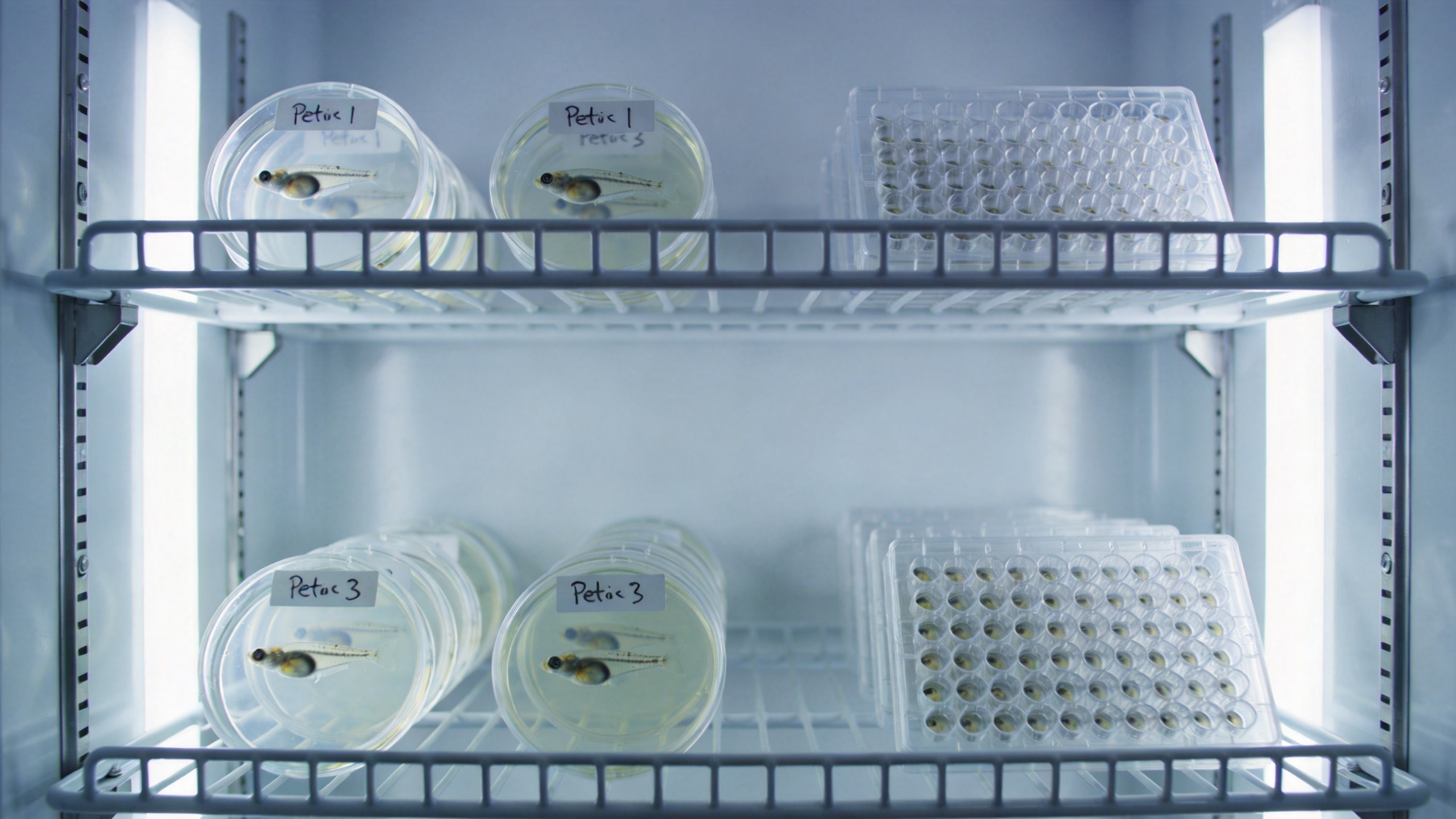
Translate Your Workflow Into a Size Requirement
Begin with the busiest realistic week, not an average week. Count the containers that must be incubated simultaneously, then classify them by footprint and by how often they must be accessed. Include repeat runs, control groups, and short-term holding periods. A capacity plan based only on routine demand can fail during a screening campaign or after an unusually productive breeding day.
| Planning question | Why it matters | What to document |
|---|---|---|
| How many vessel formats are used? | Different dishes, plates, and trays use shelf area differently. | Dimensions, height, lids, and whether stacking is permitted. |
| How many batches overlap? | Simultaneous runs define usable capacity more accurately than monthly totals. | Peak-day count, run duration, and expected repeat rate. |
| Do studies require separation? | Controls, exposure groups, or different temperatures may need independent space. | Isolation rules and dedicated shelf or chamber requirements. |
| How fast may the program grow? | Scalability prevents an early purchase from becoming a bottleneck. | Expected projects, users, and timing for the next capacity review. |
A useful rule is to leave operating headroom rather than packing every shelf. The exact margin depends on vessel geometry and the incubator’s validated loading guidance. If your priority is reproducibility, the first factor to evaluate is not the biggest stated size but the capacity that remains when airflow, access, and separation are protected.
Why Vessel Size Changes the Answer
Two labs can report the same zebrafish incubator volume and have very different usable capacity. A workflow built around low-profile multiwell plates may use shelves differently from one that relies on taller containers or multiple covered dishes. The depth of a shelf, clearance between levels, and the ability to retrieve a single vessel all influence daily capacity. Ask suppliers for an internal shelf drawing and confirm how the proposed configuration accommodates your real containers.
It is tempting to treat a larger chamber as automatically more scalable. In practice, higher zebrafish density does not scale linearly with a bigger enclosure. More material in one chamber can mean more labeling complexity, more door-open events, and more work at risk if a condition drifts. A slightly smaller but modular arrangement may offer better control for some programs.
Plan for Environmental Control Alongside Capacity
Capacity and environmental performance must be evaluated together. Temperature stability, light scheduling where relevant, humidity behavior, recovery after door openings, and alarm or monitoring features determine whether the available space can be used confidently. A chamber should not be loaded beyond the configuration for which its performance is established. Confirm the unit’s documentation for loading, shelf placement, and maintenance before converting nominal volume into a vessel count.
For embryo work, timing is particularly important. Search results for zebrafish incubation commonly emphasize controlled conditions for eggs and larvae, so capacity planning should account for the time-sensitive nature of developmental windows. Separate staging or unloading routines can be more valuable than simply adding another shelf.
A Practical Capacity Selection Checklist
- List every vessel format and its external dimensions.
- Calculate the maximum number of concurrent batches during a peak week.
- Reserve space for controls, repeats, and unexpected breeding output.
- Decide whether experiments need physical separation by protocol or temperature.
- Compare shelf configuration, access, monitoring, and recovery performance—not volume alone.
- Choose a scalable path: spare shelf capacity, a larger cabinet, or matching modular units.
- Document the validated loading pattern so each user applies the same limits.
Frequently Asked Questions
Is a larger zebrafish incubator automatically the better choice?
Not necessarily. The right size depends on vessel formats, peak simultaneous runs, access frequency, and separation needs. A large chamber may be appropriate for coordinated high-volume work, while smaller dedicated units can be easier to manage for independent studies.
How should a lab estimate capacity before buying?
Build a peak-week inventory of containers, record their dimensions, and map them to the proposed shelves. Add headroom for controls and schedule changes. Then verify the configuration against the manufacturer’s operating guidance rather than estimating from liters alone.
When does a modular setup make sense?
A modular setup is useful when demand is likely to grow in stages, when different studies need separation, or when continuity during maintenance matters. Matching units can make expansion more predictable, provided the laboratory documents and validates comparable operating conditions.
Choose Capacity That Supports the Next Study, Not Just Today’s Load
The available capacity options for a zebrafish incubator range from compact chambers to medium and large cabinets, with modular installations providing an additional path for scalability. Select based on usable shelf space, vessel size, simultaneous batches, environmental control, and the degree of separation your protocols require. A documented loading plan turns the chosen size into reliable research capacity—and makes future expansion easier to justify.








