
 EN
What Are the Key Components of a Zebrafish Rack?
A Zebrafish Rack is more than a shelf for fish tanks. In a research facility, it is a coordinated housing and water-management system designed to keep many tanks accessible while helping staff maintain consistent husbandry conditions. For a core facility manager, the useful question is not simply how many tanks fit on a rack. It is whether the rack frame, tank holders, water manifold, drain path, filtration loop, and service access work together reliably during daily feeding, cleaning, observation, and maintenance.
The exact layout varies by facility, tank size, and recirculating or standalone design. Still, understanding the main components makes it easier to compare systems and to identify what needs attention before installation. This article separates the structural parts from the water path so that a purchasing team and the people operating the system can ask practical questions.
Start with the rack frame: the system’s structural backbone
The rack frame carries the load of filled tanks, plumbing, and accessories. It also establishes the working height and spacing that determine how easily staff can reach a tank or inspect a connection. A stable frame should resist movement and remain level on the final floor surface; a small tilt can affect drainage behavior and make a row of tanks harder to manage consistently.
Look at the frame as an operating platform rather than a piece of furniture. Its uprights and cross members support the tank levels, while its footprint affects aisle clearance, access to utilities, and room for maintenance. Adjustable leveling feet can be useful where a laboratory floor is not perfectly even. If the room is shared by several users, clear access to each level matters as much as the stated tank capacity.
Tank holders keep each tank positioned and supported
Tank holders are the supports, rails, shelves, or brackets that locate individual tanks on the frame. They need to hold the tank securely while keeping its inlet, outlet, and lid accessible. A suitable arrangement for a lab is one that makes placement repeatable: staff should be able to remove a tank for cleaning or observation and return it without forcing plumbing parts out of alignment.
When reviewing tank holders, check whether they match the intended tank format and whether a full tank can be handled safely at each rack level. Also consider the clearance around tank labels, feeding openings, and outlet screens. A holder that looks compact on a drawing can become inconvenient if it blocks a routine visual check for debris, leaks, or unusual fish behavior.
The water manifold distributes controlled supply water
The water manifold is the supply header that routes conditioned water from the system loop to individual tanks or tank positions. It commonly runs along a rack level or above the tanks, with branch outlets and, in many configurations, individual flow controls. Its job is to distribute water in a predictable way, not merely to move water quickly.
Individual valves are especially helpful when a tank needs to be isolated for cleaning, observation, or troubleshooting. They also let staff check whether a low-flow concern is local to one branch or related to the wider system. However, valves only help when they are reachable and clearly identified. During procurement, ask to see how the manifold is labeled, how connections are inspected, and how a branch is serviced without disrupting the rest of the row.
Flow targets are system- and protocol-dependent, so they should be set according to the manufacturer’s guidance and the facility’s husbandry program. A rack should not be judged by a generic flow number alone. What matters is that the supply path, flow control, and tank outlet design support stable operation under the planned stocking and maintenance routine.
Drainage plumbing completes the tank-to-system water path
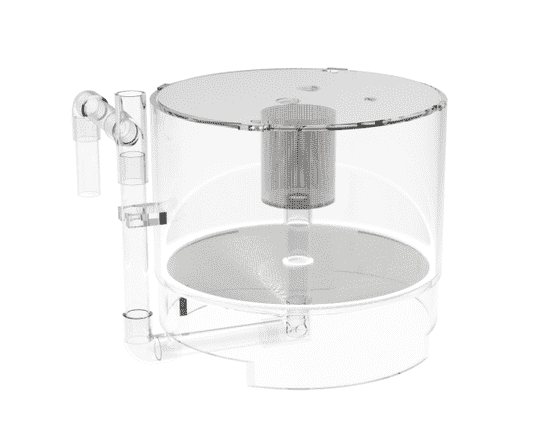
Water entering a tank must leave it in a controlled way. The drainage path typically includes tank outlets, drain lines, and a return route to the treatment area or drain, depending on the system design. In a recirculating Zebrafish Rack, the return water is normally routed back to a reservoir or filtration section before it is supplied again.
Published descriptions of open-design recirculating zebrafish housing illustrate this basic architecture: a reservoir, water supply lines, drainage lines, and staged filtration. That is a useful model for understanding the water path, not a universal specification for every commercial rack. The important point is that a facility should be able to trace water from supply to tank, through the outlet, and back to treatment without hidden areas that are difficult to inspect or clean.
Drainage deserves attention because it is where small problems often become visible first. Slow draining, clogged screens, poorly seated outlets, or a leak at a fitting can affect a single tank before they affect an entire rack. Service access, visible connections, and a clear cleaning procedure are therefore part of the component design, even though they may not appear in a short product list.
Filtration, reservoir, and pump support recirculating designs
Not every rack uses the same water-treatment arrangement, but recirculating systems generally need a reservoir, a pump, and filtration components to prepare water for reuse. The reservoir provides system volume; the pump moves water through the loop; and the filtration sequence addresses particles, dissolved contaminants, and biological waste according to the system design.
A published recirculating-system example describes early particle removal followed by finer mechanical filtration and an activated-carbon stage. Other systems may use different media, biofiltration layouts, sterilization equipment, or monitoring hardware. The point for buyers is to confirm the intended maintenance tasks: which filters are consumable, where are they located, how is access provided, and what alarms or checks help staff recognize a developing problem?
These components should be assessed with the rack itself. A high-capacity frame and many tank holders are only useful when the water-treatment loop is sized and maintained for the actual population and operating schedule. Most facilities benefit from documenting who checks the pump, water level, filters, and fittings, especially when the rack serves multiple research groups.
Electrical, monitoring, and service-access components
A complete Zebrafish Rack may also include electrical connections for pumps, lighting, monitoring devices, sterilization equipment, or alarms. The specific equipment varies, so it is better to request a documented utility plan than to assume a particular feature is included. Confirm the required power outlets, cable routing, backup arrangements, and access points before the rack is positioned against a wall.
Monitoring can include checks for temperature, water level, flow, or other husbandry-relevant conditions. The right level of monitoring depends on facility policy and system configuration. What matters most is that readings and alerts are understandable to the people who respond to them. A sensor that cannot be checked easily or an alarm without a defined response procedure provides less value than its specification sheet suggests.
Finally, leave room for service. A rack needs space around valves, filter housings, pumps, and drain connections. If a technician must move tanks or reach behind a loaded frame to complete ordinary maintenance, the layout may create avoidable disruption. This is the setup step nobody mentions until the first service visit.
A practical component checklist before you choose a rack
- Rack frame: Is it stable, levelable, appropriately sized for the room, and accessible from the working aisle?
- Tank holders: Do they match the tank format and allow safe removal, labeling, feeding, and inspection?
- Water manifold: Are branch outlets and flow controls visible, reachable, and identifiable?
- Drain path: Can staff inspect outlets, return lines, and fittings and follow a defined cleaning routine?
- Recirculation hardware: If applicable, are the reservoir, pump, filters, and any treatment devices practical to maintain?
- Utilities and service access: Are electrical needs, monitoring points, and maintenance clearances included in the installation plan?
Why component-level planning improves daily operation
A well-considered Zebrafish Rack supports more than orderly housing. It helps a laboratory make routine tasks repeatable: place a tank, confirm flow, feed fish, inspect the outlet, and perform scheduled maintenance without improvising around the hardware. Hunter Lab focuses on zebrafish instruments and applications, which is relevant when a facility needs to discuss how equipment layout fits its research workflow rather than treating aquatic housing as a generic storage problem.
Before making a decision, map the full route through the system: the rack frame supports the tank holders; the water manifold supplies each tank; the outlet and drain line return water; and the treatment components prepare the loop for the next cycle. Then ask how each part will be accessed on an ordinary workday. That component-by-component view is a more useful starting point for specifying a rack that can be operated, cleaned, and maintained with confidence.








