
 EN
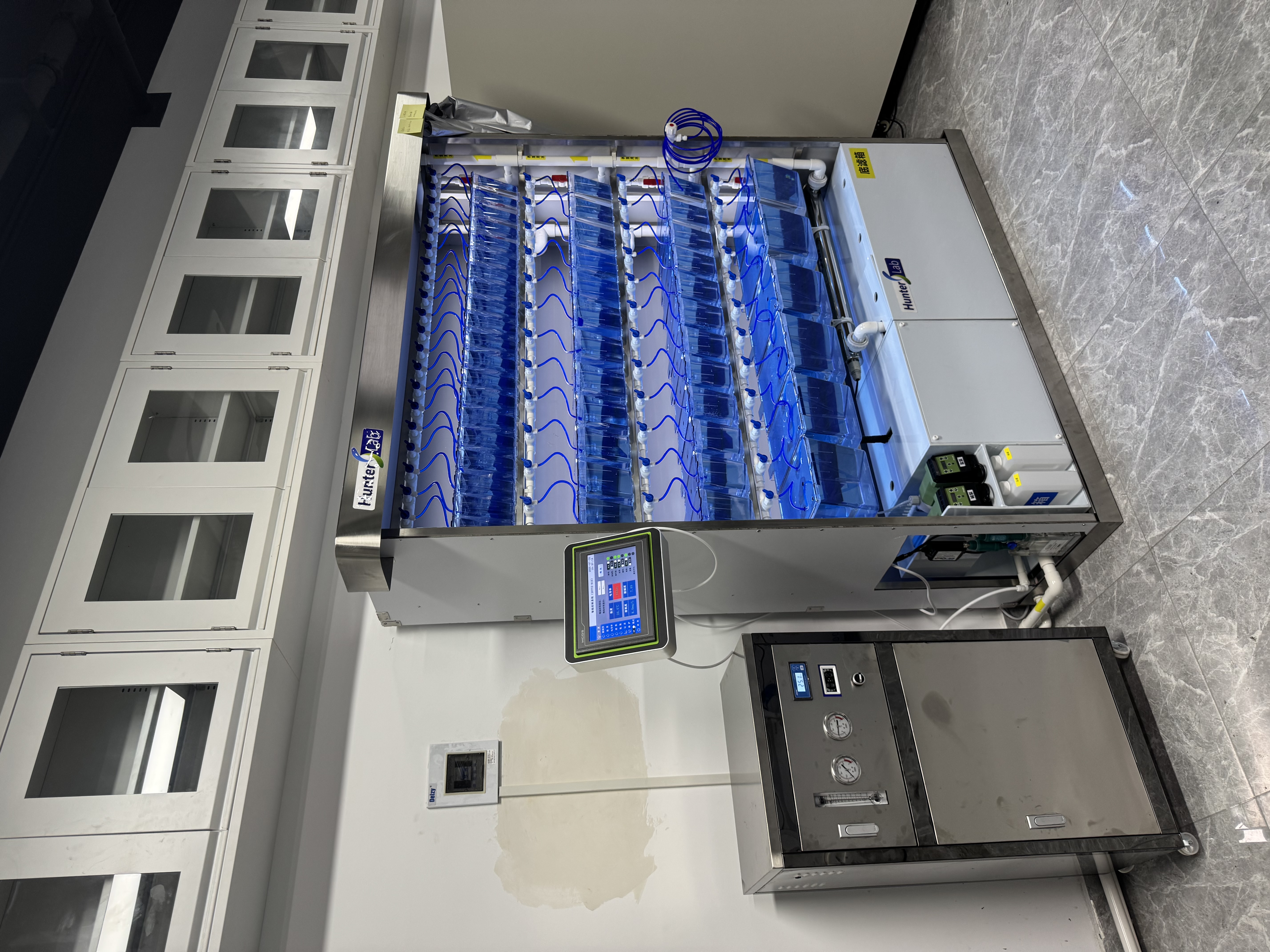
The zebrafish larva behavior analysis system supports both dark and light phase testing.
When a larval locomotor study includes illumination changes, the useful question is not simply whether fish move more or less. It is whether the experimental setup can preserve the context of that movement. A Zebrafish Larva Behavior Analysis System designed for both a dark phase and a light phase helps a laboratory examine baseline activity, responses around a transition, and the time-dependent pattern across the full session without treating one condition as disposable background.
That distinction matters in toxicology, neurobehavioral research, nutraceutical screening, and early phenotype work. Larvae can show different locomotor patterns as lighting changes, and a transition itself can be informative. Published light/dark work has described behavioral responses to a sudden move into darkness, while circadian studies have reported distinct day-night activity patterns under alternating cycles. These observations do not create a universal expected result for every strain or protocol. They do show why recording the condition and timing alongside movement is essential.
Why both phases belong in the same behavioral question
A light-only recording can establish one kind of baseline. A dark-only recording can reveal another. Neither alone necessarily explains what happens when the environment changes. With a Zebrafish Larva Behavior Analysis System, researchers can plan a session that treats the light period, the dark period, and the transition window as related parts of one behavioral experiment.
Consider a plate in which average distance traveled appears stable during a light phase but changes immediately after lights are reduced. If the analysis reports only a session-wide mean, that response may disappear into the average. Segmenting the recording by condition gives the team a more useful set of questions: Was the change immediate or gradual? Did it persist through the dark interval? Was it present in all wells or concentrated in a treatment group? Those are analysis questions, not assumptions about what any one group should do.
The same logic applies in reverse. A return to light can be evaluated as its own event rather than being folded into an undifferentiated endpoint. This is particularly helpful when an assay is intended to distinguish general hypoactivity from a condition-specific behavioral response.
Set the protocol before asking the system to compare phases
Good dual-phase testing starts with a written schedule. Define acclimation, the order and duration of each condition, the number of transitions, and the observation windows that will be compared. A Zebrafish Larva Behavior Analysis System is most useful when these choices are made before treatment groups are reviewed.
- Developmental stage: Specify the age in days post-fertilization and keep it aligned across groups. Locomotor work is often planned once larvae are reliably mobile, commonly around 5–6 dpf, but the suitable stage depends on the biological question and the laboratory’s baseline data.
- Circadian timing: Run comparable plates at comparable times. A circadian pattern can influence activity, so an afternoon plate should not be casually compared with a morning plate simply because both used the same light program.
- Acclimation: Allow a defined settling period before the first scored interval. Stress from handling or plate transfer can otherwise be mistaken for a treatment effect.
- Environmental control: Document temperature, light source settings, plate layout, and operator actions. If those conditions drift, an apparent dark-phase difference may be difficult to interpret later.
As a researcher-facing rule of thumb, the right schedule depends heavily on the endpoint and the facility routine; there is no single light/dark sequence that works for every lab. The practical gain comes from making the sequence reproducible and visible in the final dataset.
Choose endpoints that retain the phase context
Distance traveled, velocity, movement duration, inactive time, and movement-bout measures can all be useful, provided their reporting window is clear. Rather than asking for one number per well, configure the Zebrafish Larva Behavior Analysis System workflow to retain condition labels and time bins. A compact analysis table might compare a pre-transition baseline, an early-transition window, and a later stable window for each phase.
| Analysis window | What it can help reveal | Interpretation check |
|---|---|---|
| Late light-phase baseline | Activity before a programmed change | Was acclimation complete? |
| Early dark-phase transition | Immediate response to altered illumination | Is the effect transient or consistent across wells? |
| Stable dark phase | Activity after the initial response | Does the group differ from its own baseline? |
| Return-to-light period | Response to the reverse transition | Does the pattern recover, reverse, or remain altered? |
We started out measuring total distance alone, thinking it was the most direct indicator, but once we looked at phase-specific movement and transition windows alongside it, the interpretation became more defensible. This does not mean every assay requires every endpoint. It means the chosen endpoint should match the hypothesis and retain the testing conditions that give it meaning.
Build comparisons that survive review
For a treatment study, compare like with like: the same developmental stage, plate format, analysis window, and illumination schedule. Inspect controls in each phase before interpreting a difference in an exposed group. If control activity shifts between runs, revisit environmental records before pooling the data. A Zebrafish Larva Behavior Analysis System can support disciplined review when the exported data make these comparisons possible; it cannot repair an undocumented change in temperature, timing, or handling.
It is also worth separating a transition response from a sustained effect. A compound may appear to change dark-phase behavior because it affects the immediate switch response, because it affects later activity, or because it changes both. Reporting those alternatives clearly is more useful than a broad claim that the compound “increases” or “decreases” behavior.
What to confirm when evaluating a dual-phase workflow
Before starting a project, ask whether the workflow can define light and dark intervals, preserve timestamps, export well-level results, and apply the same analysis logic across plates. Confirm how the team will document exceptions such as a delayed run, an interrupted recording, or an outlier well. For laboratories serving multiple projects, these details reduce rework and make cross-run discussion more concrete.
Hunter Lab focuses on zebrafish instruments and applications, so researchers can frame these questions around the full experimental workflow rather than a generic activity readout. The final choice should still be driven by the protocol: if your priority is reproducible phase-specific behavior, evaluate first whether the system and operating procedure preserve the dark phase, the light phase, and the circadian context together.
Conclusion
Dual-condition experiments are strongest when lighting is treated as an analytical variable, not merely a room setting. A well-planned Zebrafish Larva Behavior Analysis System supports both dark and light phase testing by helping teams organize comparable windows, review transitions separately, and document the conditions behind each measurement. Start with a stable baseline, define the phase schedule in advance, and interpret movement only in the context in which it was recorded.








