
 EN
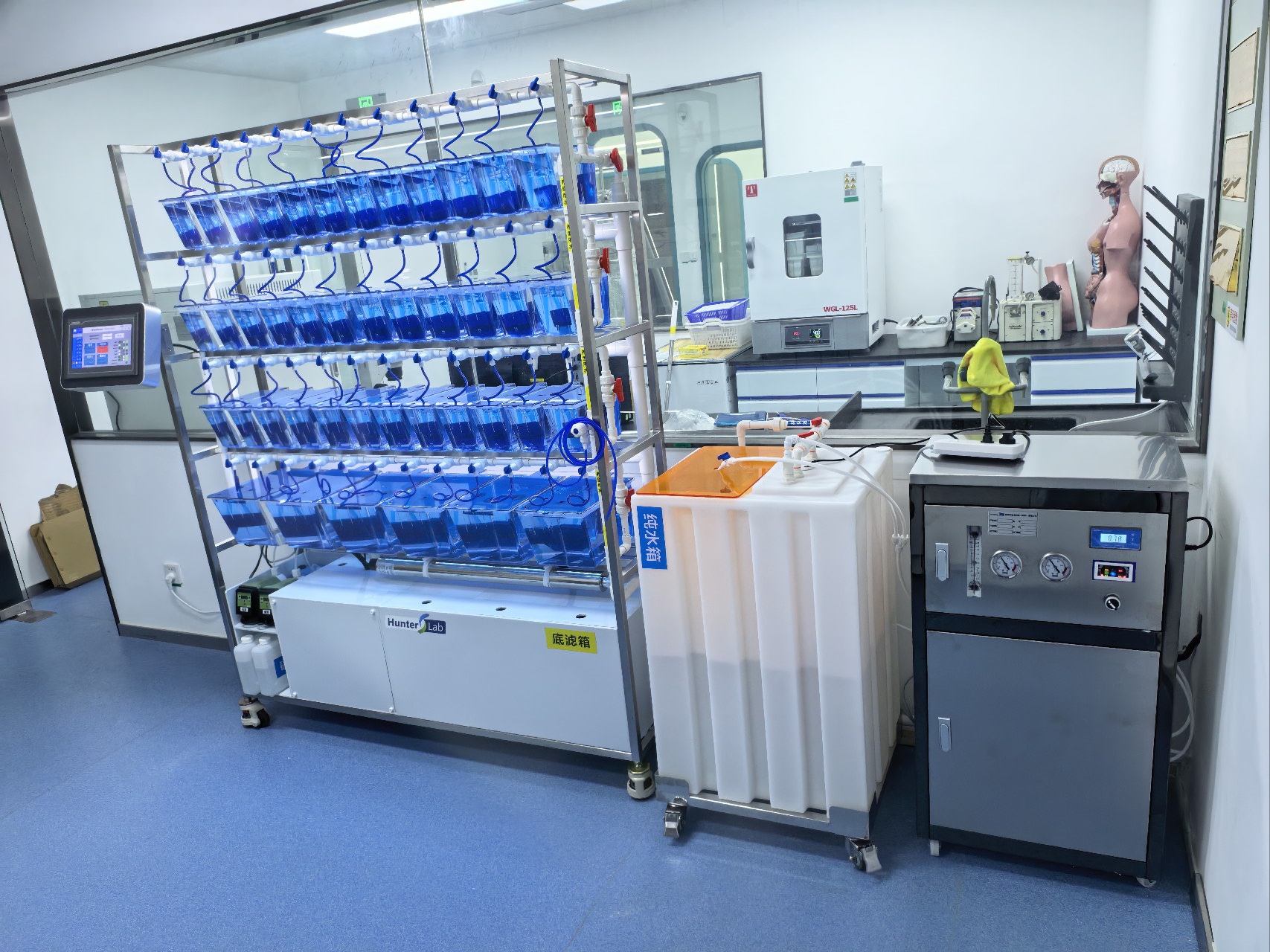
Why larval mortality is often a water flow problem in disguise
Larval mortality is one of the hardest problems to diagnose in a zebrafish facility. The larvae are small, the signs are subtle, and the cause is rarely obvious. A batch that looks fine on Monday can be mostly dead by Thursday. In many cases, the underlying cause traces back to water flow. Not flow that is too strong or too weak in an obvious way, but flow that is inconsistent, poorly distributed, or mismatched to the developmental stage of the animals.
A zebrafish breeding system that manages water flow well does more than keep tanks clean. It creates the conditions larvae need to feed, breathe, and develop without stress. That is why flow design deserves more attention than it usually gets. It is not a background parameter. It is part of the life support system.
The specific ways poor flow harms larvae
Larvae are not miniature adults. Their tolerance for environmental variation is narrower, and their ability to compensate is lower. Several flow-related problems hit them harder than they hit adults.
-
Strong flow pushes larvae against tank walls and prevents them from feeding effectively.
-
Weak flow allows waste and uneaten food to accumulate near the bottom.
-
Uneven flow creates dead zones where oxygen drops and ammonia rises.
-
Pulsing flow from oversized pumps adds stress that larvae cannot adapt to.
Each of these problems shows up differently. Larvae in a high-flow tank may look thin and fail to grow. Larvae in a low-flow tank may develop infections. Larvae in a tank with uneven flow may show a patchy survival pattern, with some areas thriving and others failing. Recognizing the pattern is the first step toward fixing the underlying design.
Matching flow rate to larval developmental stage
One of the most common mistakes in breeding system design is applying a single flow rate across all life stages. Adults can handle relatively strong currents. Larvae cannot. The flow rate that keeps an adult tank clean can be overwhelming for a five-day-old larva.
A better approach is to design the system with stage-specific flow zones. Larval racks can use gentler flow rates, often achieved through smaller pumps, wider distribution manifolds, or flow restrictors at each tank. Adult racks can use higher rates. The two zones share the same sump and filtration, but the delivery is tuned to the animals in each zone.
| Life stage | Typical flow need | Main risk if wrong |
|---|---|---|
| Embryo (0 to 3 dpf) | Very gentle, near static | Mechanical damage, dislodging |
| Early larva (4 to 10 dpf) | Gentle, steady | Feeding difficulty, wall trapping |
| Late larva (11 to 20 dpf) | Moderate, steady | Waste accumulation |
| Juvenile | Moderate to strong | Uneven growth |
| Adult | Strong, well distributed | Waste buildup, low oxygen |
The table is a general guide. The right values depend on tank size, stocking density, and the specific system design.
Distribution and manifold design for even flow
Flow rate at the pump is only half the story. What matters to the larvae is the flow they actually experience in their tank. If the manifold delivers more water to the first tanks on the line and less to the ones at the end, the animals in those tanks live in different conditions. That is a problem for reproducibility as well as for welfare.
A well-designed manifold balances pressure across all outlets. This can be achieved through careful pipe sizing, balanced valves, or pressure-compensating emitters. Some systems use a looped manifold rather than a linear one, which reduces the pressure drop from the first outlet to the last. The goal is that every tank in the rack receives a similar exchange rate.
Verification matters too. A flow meter at the pump does not confirm that each tank is getting its share. Periodic checks at individual tanks, or flow sensors on each rack section, provide the data needed to catch imbalance before it affects survival.
Aeration, oxygen, and the interaction with flow
Flow and aeration are linked. Water movement at the surface drives gas exchange. In a low-flow tank, the surface may be calm, and oxygen can drop faster than expected, especially when larvae are dense or when water temperature is high. In a high-flow tank, oxygen may be plentiful, but the mechanical stress on the larvae can be harmful.
A balanced system provides enough surface agitation to maintain oxygen without creating a current that exhausts the larvae. Air stones, diffusers, or return line design can all contribute. The key is to measure dissolved oxygen in representative tanks, not just at the sump, and to adjust as the larvae grow.
A field example from a facility that traced mortality to flow
A facility in southern China had been losing larvae at a rate that seemed too high for the protocols in use. The water parameters at the sump were within range. Filtration was working. Feeding schedules were followed. Mortality was still higher than expected, and it was not uniform. Some tanks did well and others failed, even within the same rack.
A review of the rack layout revealed that the distribution manifold had been installed in a way that favored the first few tanks on each row. Those tanks received stronger flow, while tanks at the end of the row received much less. The larvae in the low-flow tanks were experiencing slower water exchange, which allowed waste to build up. The larvae in the high-flow tanks were being pushed against the mesh. Both groups were stressed.
The fix involved rebalancing the manifold, adding flow restrictors to the first outlets, and verifying the exchange rate at each tank. Larval survival improved across the rack. The protocol had not changed. The flow had.
What flow optimization can and cannot do
Optimizing flow is powerful, but it is not a cure for every problem. It will not fix poor water quality from an undersized filter, a contaminated feed culture, or a disease outbreak. It will not compensate for overcrowding or temperature swings. Flow is one part of a system that has to work together.
It is also worth remembering that flow needs change as the animals grow. A system that is set correctly for larvae may need adjustment as those larvae become juveniles. Periodic review of flow rates, oxygen levels, and survival data keeps the system tuned. Static settings tend to drift out of alignment with the biology over time.
Hunter Lab (Hunter) builds zebrafish laboratory equipment with attention to the flow dynamics that larval rearing depends on. The manufacturing and quality control side supports the consistency that long-term colony management requires. For facilities working to reduce larval mortality, that kind of build discipline is part of the foundation.








