
 EN
Why capacity planning starts with the science, not the hardware
A new research facility often begins with a list of equipment. Microscopes, incubators, storage tanks, and racks all get specified. The reproduction system sometimes gets treated as an afterthought, sized to whatever space is left. That order is backwards. The science drives the capacity requirement, not the other way around.
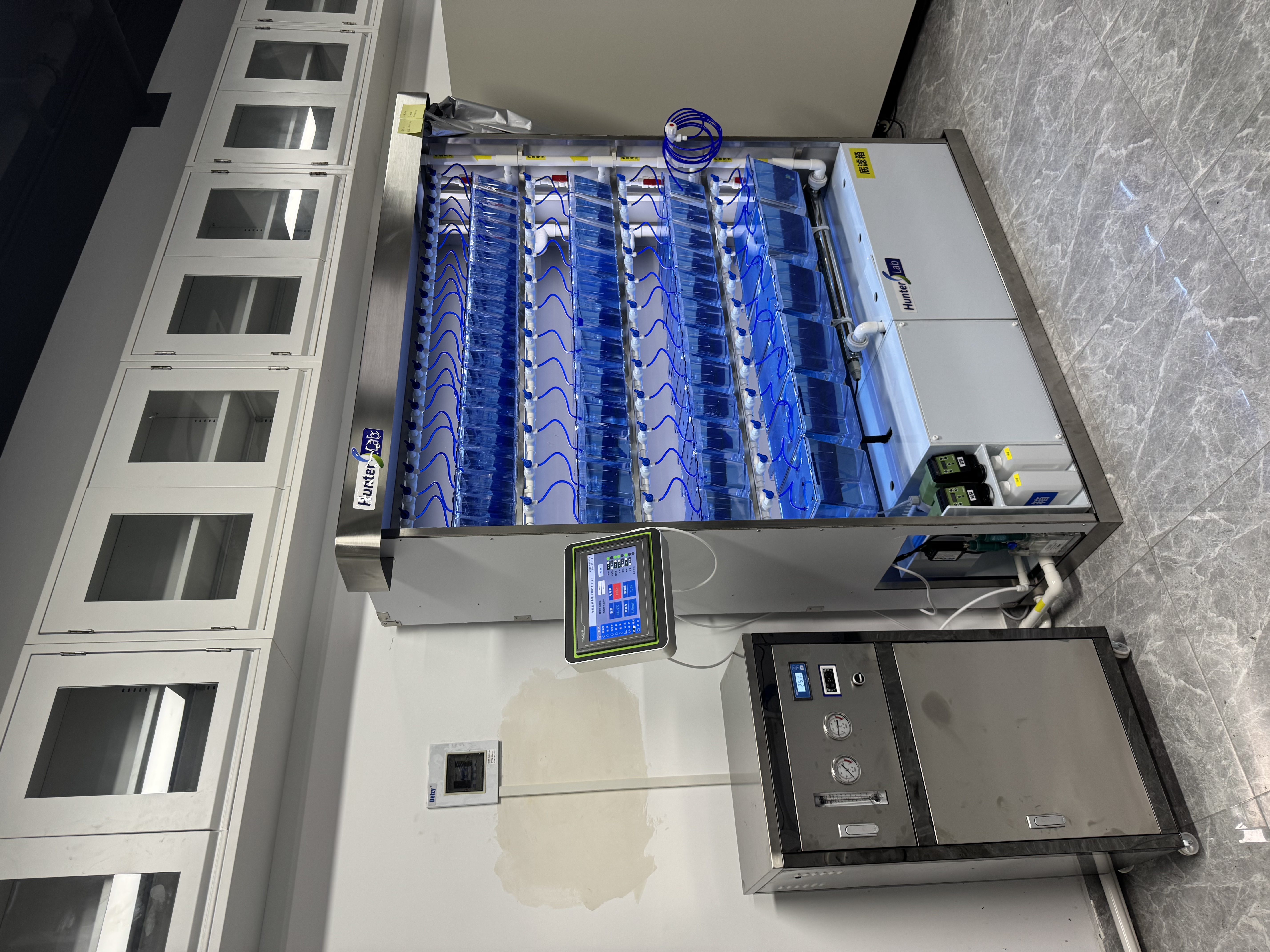
A zebrafish reproduction system exists to deliver embryos and larvae at the stage and quantity that experiments demand. If a facility plans for ten breeding tanks but runs six projects that each need synchronized embryos every week, the system will be a bottleneck from day one. Capacity planning is really a question of matching the system to the research portfolio.
Mapping colony size and spawning frequency to tank numbers
The first step is to estimate how many embryos the facility needs on a routine basis. A developmental biology lab might need a few hundred embryos per week for imaging. A toxicology group running multiwell plate assays might need thousands. Those numbers translate into breeding pairs, and breeding pairs translate into tank space.
Adult zebrafish can spawn regularly when maintained under a 14-hour light and 10-hour dark cycle, a standard recommendation from The Zebrafish Book. A single pair can produce a few hundred eggs in a spawn, but not every pair spawns every day. A realistic planning assumption is that only a fraction of pairs will produce usable embryos on any given day. That fraction depends on nutrition, water quality, and genetics.
-
Estimate weekly embryo demand across all active projects.
-
Divide by the average yield per spawning pair.
-
Adjust for the proportion of pairs that actually spawn.
-
Add a buffer for failed spawns and new projects.
The result is a rough number of breeding tanks. That number then drives the size of the recirculating system, the filtration capacity, and the room layout.
The hidden load: water quality, filtration, and labor
Tank count is only the visible part of capacity. Every additional tank adds bioload, which the filtration system has to handle. Ammonia and nitrite must stay near zero, and dissolved oxygen has to remain adequate. A system sized for the average load will struggle during peak spawning weeks, when feeding increases and metabolic waste rises.
Labor is another hidden constraint. More tanks mean more feeding, more water changes, and more health checks. A facility that plans for the animals but not the staff will find that routine tasks slip, and water quality follows.
| Planning factor | Underestimated approach | Realistic approach |
|---|---|---|
| Adult tanks | Sized to current colony | Includes breeding surplus and quarantine |
| Embryo space | One rack for all projects | Separate racks for staggered experiments |
| Water treatment | Sized to average load | Sized to peak load plus margin |
| Labor | Shared among researchers | Dedicated animal care time |
The table is not a precise formula. It is a reminder that capacity has several dimensions, and the biological one is only the first.
Where a small buffer saves a facility from daily crises
A facility that runs at 100 percent utilization has no room for error. A failed spawn, a contaminated tank, or a sudden grant-funded project can push the system past its limit. A buffer of spare tanks and embryo space is not waste. It is the difference between a smooth week and a scramble.
The size of that buffer depends on the facility's risk tolerance and the variability of its research. A lab with a single, well-characterized assay might need a small buffer. A core facility serving many users with unpredictable needs should plan for more.
It is also worth planning for expansion. Adding a few extra racks during initial construction is far cheaper than retrofitting a room later. The plumbing, electrical, and floor space can be designed with growth in mind, even if the tanks are not installed immediately.
A field example from a new facility build
A research institute in eastern China built a new zebrafish facility with a reproduction system sized to its existing colony. The initial plan assumed that current spawning rates would continue. Within the first year, two new labs joined the institute and began running developmental studies that required synchronized embryos every week. The breeding racks were quickly oversubscribed.
The team had to convert a storage room into additional breeding space and upgrade the filtration system. The retrofit cost more than the original planning would have, and it disrupted ongoing experiments for several weeks. The lesson was not that the original estimate was wrong. It was that capacity planning has to account for growth and for the collective demand of multiple users, not just the founding lab.
How Hunter Lab fits into the capacity picture
Hunter Lab (Hunter) builds zebrafish laboratory equipment with attention to the practical realities of facility planning. The manufacturing and quality control side supports the consistency that multi-rack reproduction systems require. For teams specifying a new facility, that kind of build discipline is worth factoring into the capacity plan.








