
 EN
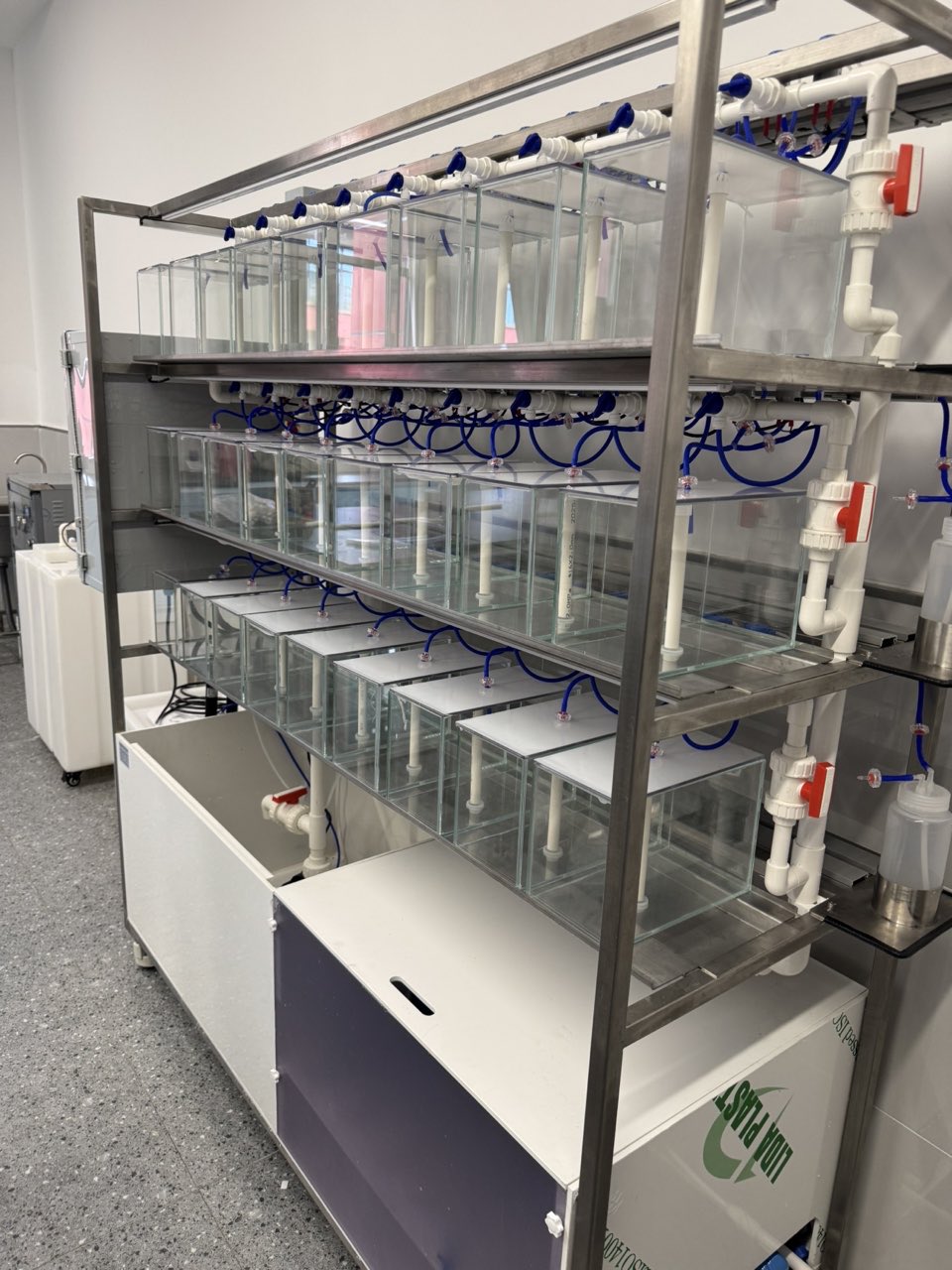
How does a zebrafish toxicological exposure system support drug development?
A zebrafish toxicological exposure system gives a preclinical team a controlled way to ask a practical question early: what happens to a living vertebrate organism when a candidate compound reaches it at a defined concentration and for a defined period? For study teams deciding which molecules merit further work, the value is not a single pass-or-fail readout. It is the ability to align exposure, observation, and analysis before a safety signal becomes an expensive late-stage surprise.
From a preclinical study-design perspective, a zebrafish toxicological exposure system is most useful when it is treated as an evidence-generating workflow rather than a tank plus an imaging station. The workflow begins with compound preparation and dosing logic, continues through environmental and biological controls, and ends with a traceable decision about whether to move a candidate forward, reformulate it, investigate it, or deprioritize it.
What the system adds to early drug development
Cell-based assays remain important for identifying mechanism-linked hazards, but they do not show every organism-level response. A zebrafish toxicological exposure system adds a whole-organism layer in which development, morphology, circulation, movement, and survival can be observed together. That makes it useful for screening a series of related molecules, comparing concentration-response patterns, and deciding which findings need deeper mammalian or in vitro follow-up.
For drug development, the operational advantage comes from consistency. A zebrafish toxicological exposure system can define the age or developmental stage of the fish, the exposure window, test concentrations, vehicle controls, replicate layout, water conditions, and imaging or scoring schedule. When those elements are written into the protocol, an observed change can be interpreted against a known context instead of being treated as an isolated image or anecdote.
This does not turn zebrafish into a replacement for every preclinical model. Species biology, absorption, metabolism, distribution, and target relevance still matter. Rather, a zebrafish toxicological exposure system can help teams organize early evidence so that later studies focus on the candidates and questions that warrant them.
Exposure control is the foundation of interpretable data
The central job of a zebrafish toxicological exposure system is to make delivered exposure as understandable as possible. A nominal concentration on a preparation sheet is not automatically the concentration experienced by an embryo or adult fish. Solubility, adsorption to plastic, evaporation, degradation, feeding, flow rate, and renewal timing may alter the exposure environment. Study planning should therefore pair each concentration group with a documented preparation method and, where relevant, analytical confirmation of concentration stability.
Depending on the compound and study objective, a zebrafish toxicological exposure system may use static, semi-static renewal, or flow-through conditions. Static exposure can simplify short experiments, while scheduled renewal can reduce uncertainty from changing test solutions. Flow-through approaches can be useful when the protocol needs sustained delivery or when a compound’s concentration may drift in a closed vessel. The appropriate format follows the scientific question, not a generic preference.
Controls make these choices interpretable. A sound zebrafish toxicological exposure system includes an untreated or dilution-water control and, when a solvent is used, a vehicle control. Positive controls, acceptance criteria, and recording of water temperature, dissolved oxygen, pH, and conductivity can further distinguish a compound-related pattern from a handling or environmental issue.
Endpoints connect exposure to screening decisions
A zebrafish toxicological exposure system supports screening because multiple endpoints can be recorded within the same study plan. Early developmental observations may include survival, hatching progress, body shape, edema, pigmentation, or organ morphology. Functional observations can include locomotor behavior, cardiac rhythm, blood-flow-related measures, or stimulus response when the method is fit for purpose. The key is to specify endpoints before reviewing the data and to use scoring definitions that another operator can apply.
OECD Test Guideline 236 provides one useful example of disciplined endpoint planning for fish embryo acute toxicity. It describes a 96-hour exposure period and records four apical lethality observations at 24-hour intervals: coagulation of fertilized eggs, lack of somite formation, failure of the posterior embryo to separate from the yolk sac, and lack of heartbeat. A drug development study does not automatically follow that guideline, yet the framework illustrates why a zebrafish toxicological exposure system benefits from time-stamped assessments and prespecified observations.
For a screening campaign, a zebrafish toxicological exposure system can turn those observations into a tiered decision. A candidate with no concerning findings across the planned concentration range may move to the next evidence package. A candidate showing a concentration-related developmental or functional signal may be routed to exposure confirmation, mechanistic assays, analogue comparison, or revised chemistry. This is more useful than treating every visible difference as the same type of safety concern.
How the system supports safety and preclinical prioritization
Safety decisions improve when exposure records and endpoint records can be reviewed together. A zebrafish toxicological exposure system should retain the batch identity, developmental timing, concentration calculations, solution-renewal log, environmental conditions, image files, and scoring rules. That audit trail allows a toxicologist to ask whether an effect tracks concentration, whether it occurred across replicates, and whether an unusual plate or water-quality event may explain it.
In preclinical research, the same zebrafish toxicological exposure system can support comparison across a chemical series. The goal is not to claim human safety from a single zebrafish experiment. Instead, it is to identify patterns that help a team allocate confirmatory work: for example, whether structural changes accompany a functional phenotype, whether a narrow exposure range separates an effect from an unaffected group, or whether a formulation changes the observed profile.
This approach is particularly valuable when speed must be balanced with scientific discipline. A zebrafish toxicological exposure system can generate structured data early, while its controls and metadata make the output easier to compare across runs. That can reduce ambiguity during portfolio reviews, where teams need to understand both the observed signal and the confidence attached to it.
Reproducibility depends on protocol detail
Interlaboratory zebrafish toxicology research has highlighted variation in exposure scenarios, captured endpoints, and data analysis. A zebrafish toxicological exposure system addresses that challenge only when the laboratory defines the variables it will control. Clear instructions for embryo selection, randomization, blinding where practical, exclusion criteria, imaging settings, and statistical analysis should be part of the protocol rather than added after results are known.
For teams using automated imaging or scoring, a zebrafish toxicological exposure system should also document algorithm versions, threshold settings, and manual-review rules. Automation can increase throughput, but it does not remove the need to inspect unusual findings or verify that a model performs appropriately across different morphologies and lighting conditions.
A practical implementation sequence
- Define the decision: State whether the study is intended for hazard triage, concentration selection, mechanism follow-up, or comparative screening.
- Design exposure: Select life stage, dosing range, vehicle, duration, renewal or flow plan, and environmental monitoring for the compound’s properties.
- Predefine endpoints: Set biological and functional measures, observation times, acceptance criteria, and rules for interpreting concentration-response patterns.
- Run controlled comparisons: Use appropriate control groups, replicate structure, randomization, and standardized records.
- Integrate the evidence: Compare zebrafish findings with chemistry, in vitro, pharmacology, and any exposure data before making a drug development decision.
Use the results as one line of evidence
A zebrafish toxicological exposure system is strongest when it is integrated with, not separated from, the rest of the preclinical package. An observed effect may lead to targeted mechanistic work, improved exposure characterization, a change in the compound series, or a decision to use another model. Conversely, an absence of findings within a defined system describes the tested conditions; it does not establish broad safety.
For drug development teams, that balanced interpretation is the point. A well-designed zebrafish toxicological exposure system makes early screening more traceable, helps organize safety questions around measurable endpoints, and supplies a practical bridge between cell-based assays and later in vivo research. Its contribution comes from controlled exposure and transparent decisions, not from overextending what one model can answer.








