
 EN
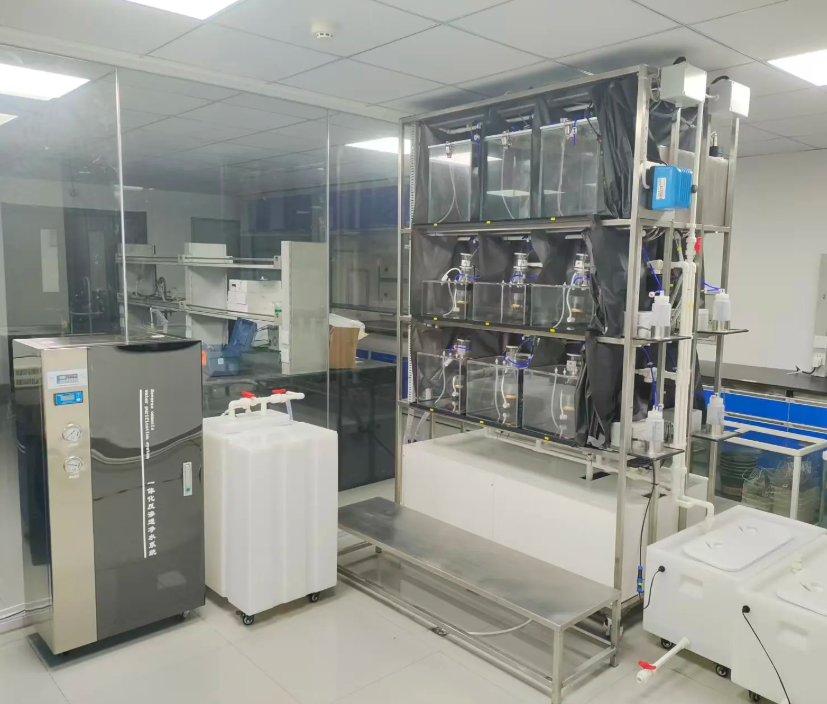
Why manual water changes drain more than time
Manual water changes look simple on paper. Drain a portion, replace it with conditioned water, check temperature, and move on. In a facility with dozens or hundreds of tanks, that routine turns into a daily grind. The time cost is obvious. The less obvious cost is consistency. Every person who performs a water change introduces small variations in volume, temperature, and water chemistry. Over weeks, those variations can add up to measurable differences in fish health and experiment reproducibility.
A zebrafish facility typically maintains water at a narrow temperature range around 28 degrees Celsius and a specific pH and conductivity. Manual changes depend on the operator matching those parameters by eye or with handheld meters. It works, but it is not scalable. When a facility grows, the labor burden grows with it.
What a water changer actually automates
A water changer is not a single device. It is a system that handles the drain, the refill, and often the conditioning steps in a controlled sequence. The simplest units replace a fixed volume on a timer. More advanced systems monitor conductivity, temperature, and pH, and adjust the incoming water to match setpoints before it enters the tank.
-
The system drains a programmed volume from the tank or rack.
-
Fresh water passes through conditioning stages, such as carbon filtration and UV treatment.
-
Temperature is adjusted to match the tank.
-
The conditioned water is delivered at a controlled rate.
-
Sensors log the event for records.
The automation does not remove the need for maintenance. It shifts the work from daily manual labor to periodic checks and calibration. That shift is what makes a water changer useful in a facility that runs continuous experiments.
Keeping water chemistry stable between changes
Water chemistry stability is where automated changes earn their keep. Fish are sensitive to rapid shifts in pH, hardness, and dissolved oxygen. A manual change that is slightly off can stress the animals without causing obvious mortality. That stress may show up later as reduced spawning, slower growth, or altered behavior.
Automated systems reduce those swings by delivering water that is already conditioned and temperature matched. The change happens gradually, often over a longer period than a manual dump and refill. That gradual approach is closer to what happens in a natural system and less likely to trigger a stress response.
| Parameter | Manual change risk | Automated change risk |
|---|---|---|
| Temperature | Moderate, depends on operator | Low, controlled by mixing valve |
| pH | Moderate, depends on source water | Low, adjusted to setpoint |
| Conductivity | Moderate, requires measurement | Low, monitored and adjusted |
| Volume accuracy | Variable | Consistent |
| Labor per change | High | Low |
The table is not a promise of perfection. Automated systems still need calibration and occasional sensor replacement. But the day-to-day variability drops.
Reducing stress on fish and staff
Fish stress is not the only concern. Staff stress matters too. A facility that depends on manual water changes has to schedule those changes around experiments, feeding, and cleaning. When someone calls in sick or a experiment runs long, the water change can be delayed. Delayed changes can lead to water quality decline, which then requires a larger corrective change, which is more stressful for the fish.
Automation breaks that cycle. The system runs on schedule regardless of staffing. Staff can focus on observation, health checks, and experimental work. That change in workflow often improves job satisfaction and reduces turnover in animal care roles.
Integration with racks and filtration systems
A water changer does not operate in a vacuum. It has to connect to the rack or tank system, the water supply, and the drain. Integration is where a lot of deployments succeed or fail. The system needs to match the flow rate of the rack, the pressure of the supply line, and the drainage capacity.
Compatibility with existing filtration is another factor. Some facilities use recirculating systems with biofilters. Others use static tanks with independent filtration. A water changer that works well with one may need modification for the other. Checking those details before purchase saves a lot of frustration.
Where automation still needs a human eye
Automation is not a substitute for observation. Sensors drift. Tubing clogs. Valves stick. A water changer that runs without any human oversight can fail silently and cause more harm than a manual system that gets checked daily.
A practical approach is to keep a daily visual check. Look at the water level, the flow indicator, and the tank inhabitants. Check the sensor readings against a handheld meter once a week. Keep a log of calibration dates. Those habits catch most problems before they become emergencies.
During a project at a university facility in southern China, a team installed automated water changers across several racks. The first month went smoothly. Then a slow clog developed in one unit. The flow rate dropped, but the system did not alarm because the sensor was downstream of the clog and still read normal. A daily visual check caught the low water level in one tank. The clog was cleared, and the team added a flow sensor upstream of the delivery point. The lesson was not that automation failed. It was that automation needs a simple human check to back it up.
Hunter Lab (Hunter) builds zebrafish laboratory equipment with attention to the daily realities of facility work. The manufacturing and quality control side supports the consistency that automated water management requires. For labs looking to reduce manual maintenance without losing oversight, a well-integrated water changer is one of those upgrades that pays back in quieter mornings.








