
 EN
Advanced zebrafish phenotype analysis systems support multi-parametric data collection.
For a research team, a Zebrafish Phenotype Analysis System is valuable when it turns observations made at different moments, by different operators, into a dataset that can still be compared. The practical goal is not simply to acquire clearer images. It is to connect morphology, viability, cardiac activity, locomotion, exposure conditions, and analysis decisions in one traceable workflow. That is what makes multi-parametric data collection useful rather than merely extensive.
From cardiovascular phenotype-screening work, one lesson is consistent: a single striking endpoint can start a conversation, but a well-structured set of endpoints is usually more helpful for deciding what to investigate next. A Zebrafish Phenotype Analysis System should therefore make the relationship between an observation, its timepoint, the embryo or larva, and the assay condition explicit.
Why a phenotype system needs more than image capture
Images are often the entry point for zebrafish analysis because embryos and larvae make developmental changes accessible. Yet image capture alone does not establish whether a visible difference is reproducible, exposure-related, or linked to a functional outcome. A comprehensive workflow adds identifiers, experimental metadata, acquisition settings, and a defined scoring scheme around each image or video. It also preserves the negative and positive controls that give an apparent phenotype its context.
Consider the disciplined observation schedule in the OECD fish embryo acute toxicity test. The guideline describes a 96-hour exposure and records four apical lethality observations every 24 hours: coagulation, lack of somite formation, lack of tail-bud detachment from the yolk sac, and lack of heartbeat. This is a useful design lesson, not a claim that every phenotype program is an OECD study. The lesson is that data collection becomes more interpretable when endpoints, timepoints, and decision rules are defined before the first plate is read.
Build the data model before selecting every readout
A capable Zebrafish Phenotype Analysis System starts with a simple question: what must a future reviewer be able to reconstruct? For most discovery, safety, or mechanism studies, the answer includes the biological unit, developmental stage, treatment, concentration, exposure window, plate and well position, acquisition time, raw-file reference, processing version, and endpoint score. If a workflow cannot reconnect those fields, a promising pattern can become difficult to verify later.
Controlled terminology matters here. The Zebrafish Phenotype Ontology provides vocabulary for describing zebrafish phenotypes, and its broader lesson is practical: agree on labels before a project generates thousands of records. A lab does not need to force every observation into a single code on day one. It does need to avoid treating “abnormal,” “reduced,” or “changed” as interchangeable labels when different operators may mean different things.
- Identity layer: clutch or breeding event, developmental stage, specimen ID, and plate/well position.
- Exposure layer: test material, concentration, vehicle, dosing window, environmental conditions, and controls.
- Acquisition layer: microscope or camera setting, magnification, illumination, capture time, and operator or automated method.
- Phenotype layer: predefined morphology, survival, cardiac, behavior, or fluorescence measures with units or scoring rules.
- Provenance layer: raw-file location, algorithm version, reviewer decision, exclusions, and reason for exclusion.
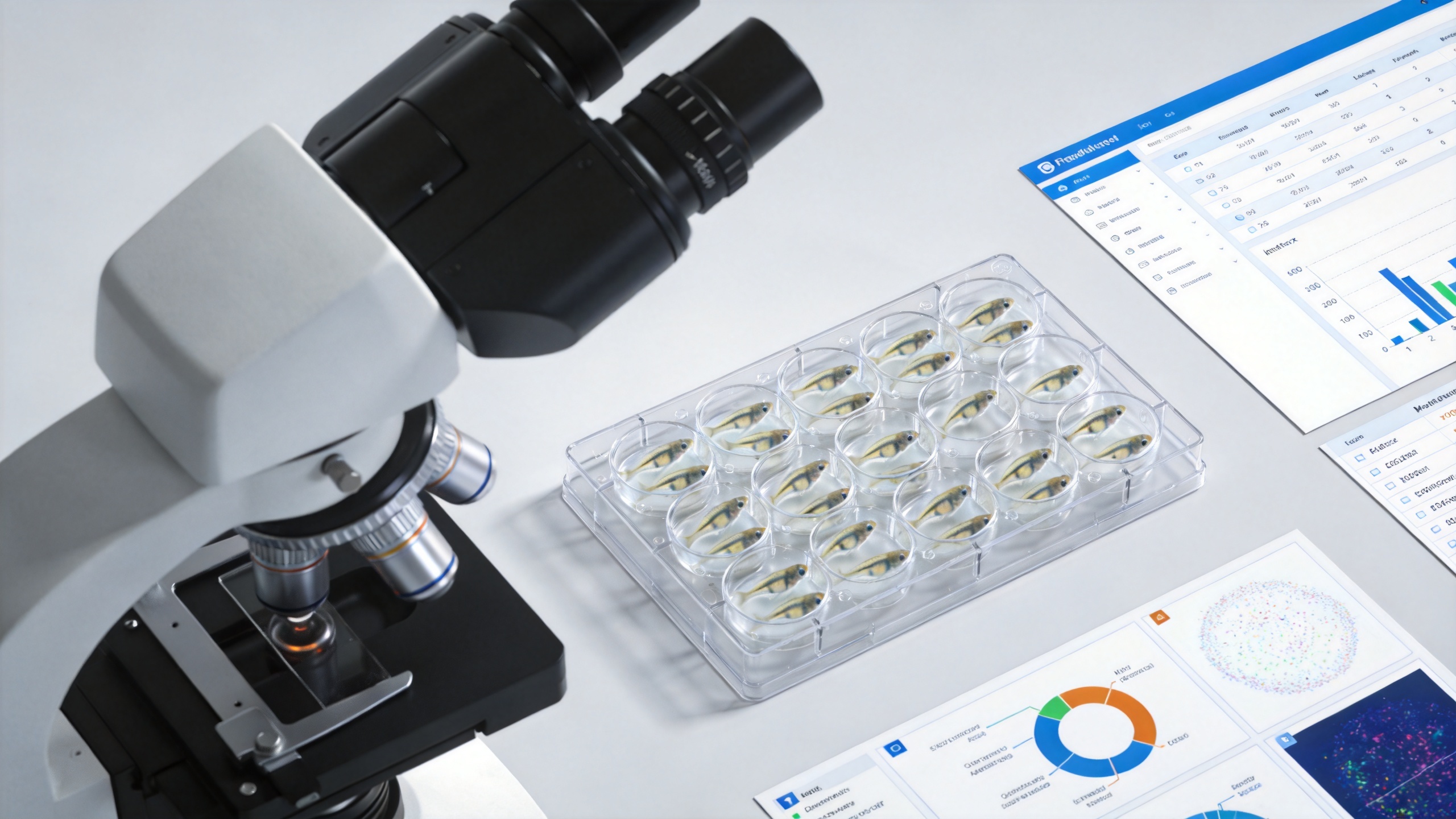
Choose complementary parameters, not an indiscriminate list
More parameters do not automatically produce better science. The strongest multi-parametric panel pairs a primary biological question with readouts that can clarify it. For example, a developmental screen may combine survival, gross morphology, body length, edema scoring, and a timed cardiac observation. A neuroactive-compound study may add locomotor activity or light/dark response. If fluorescence is relevant, the workflow should specify whether the outcome is signal presence, intensity, area, localization, or a normalized ratio.
Sensitivity and specificity need separate consideration. A broad morphology score can flag a developing problem quickly, but it may not identify the mechanism. A narrowly defined cardiac measure may be more informative for a cardiovascular hypothesis, but only when orientation, timing, and image quality are sufficiently consistent. In practice, the right balance depends on the question, the expected effect size, and what the team can measure reproducibly.
Automated behavioral tracking can be a complementary modality because it converts movement patterns into quantitative features rather than relying only on visual impressions. Still, behavior data require equally careful context: acclimation, stimulus timing, arena conditions, developmental stage, and exclusion rules can all influence an interpretation. A Zebrafish Phenotype Analysis System should keep these conditions alongside the behavioral output rather than in a separate spreadsheet.
Design an acquisition workflow that protects comparability
The most common data-quality problems are often introduced before analysis. Uneven illumination, variable anesthesia duration, inconsistent larval orientation, drifting acquisition windows, and manual renaming can all break comparability across a plate or between runs. The remedy is rarely a single piece of hardware. It is a workflow that makes the critical setup steps visible and repeatable.
- Define the primary endpoint and the minimum complementary endpoints before starting the run.
- Lock the observation schedule, capture settings, and file-naming convention in the protocol.
- Use plate maps and sample identifiers that travel with raw images, videos, and derived results.
- Record quality-control flags at acquisition, not after a reviewer can no longer see the original condition.
- Version the analysis pipeline so a reprocessed dataset is distinguishable from the first pass.
We have found that a small amount of structure at capture prevents much larger reconciliation work later. This does not mean every assay needs maximal automation. It means manual and automated steps should leave a clear audit trail (especially when a measurement, exclusion, or phenotype call is changed after review).
Turn comprehensive outputs into a reviewable decision path
A comprehensive dataset is most useful when reviewers can move from summary to evidence. Start with a plate-level view for control performance and missingness. Then allow a reviewer to filter by treatment, timepoint, or phenotype class, open the associated image or video, and see how the score was produced. Correlation plots or multivariate summaries can help prioritize patterns, but they should not conceal raw observations, replicate counts, or quality flags.
For teams evaluating a Zebrafish Phenotype Analysis System, ask practical questions: Can the workflow retain raw-to-derived traceability? Can it synchronize multiple endpoints without overwriting original observations? Can reviewers distinguish an absent value from a failed measurement? Can the export preserve the metadata needed for a statistician, study director, or collaborator to understand the result? These questions are often more revealing than a long feature checklist.
Use multi-parametric data to guide the next experiment
The appropriate conclusion from a phenotype screen is often a focused next step, not a universal biological claim. When morphology, viability, physiology, and behavior point in the same direction, the result may justify a confirmatory assay, a narrower dose range, a different developmental window, or orthogonal testing. When the parameters disagree, that disagreement can be informative too: it may expose a timing issue, a confounding stress response, or a readout that needs validation.
Hunter Lab supports zebrafish-focused technical resources and cardiovascular assay discussions for laboratories working through these workflow choices. A thoughtful Zebrafish Phenotype Analysis System keeps the experiment’s scientific question in charge: collect only the parameters that can be interpreted together, document how they were acquired, and preserve enough context for the next decision to be credible.








