
 EN
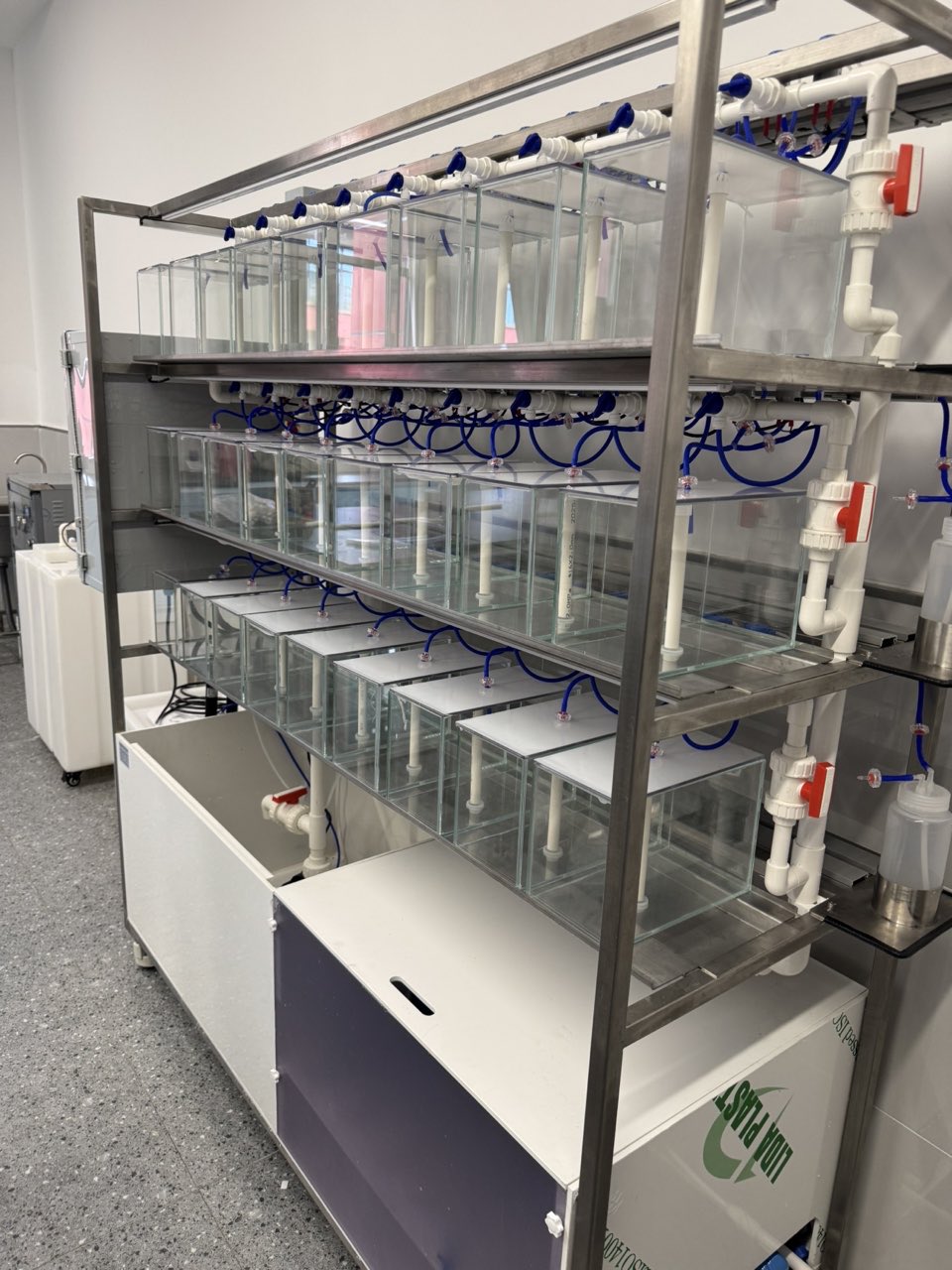
A zebrafish larva behavior analysis system enables non-invasive developmental toxicity screening.
Developmental toxicity studies often begin with a difficult choice: obtain richer functional evidence early or preserve living larvae for follow-up observations. A Zebrafish Larva Behavior Analysis System helps laboratories reduce that trade-off. By recording locomotor responses from living larvae and converting video into defined behavioral measures, it can add a functional layer to a non-invasive screening workflow.
For teams working in pharmaceutical, cosmetic, nutraceutical, or academic research, the goal is not to replace every established assay with one output. The useful role of a Zebrafish Larva Behavior Analysis System is to make early comparisons more systematic: keep exposure conditions controlled, record behavior consistently, and interpret locomotor change alongside survival, morphology, hatching, and other study-specific observations.
Why larval behavior belongs in a developmental toxicity screen
Visible malformations and mortality are important endpoints, but they do not capture every treatment-related change that may appear in a living larva. Locomotor behavior can provide another observable response. When a protocol is defined in advance, changes in distance moved, activity timing, velocity distribution, or responses to light and dark transitions can help researchers prioritize concentrations or compounds for additional work.
This is particularly useful for developmental toxicity screening because the same cohort can remain available for repeated observation. A camera-based workflow is non-invasive: it observes larvae in their wells or arena rather than requiring an endpoint collection step. That does not make every behavioral change toxicologically specific. It does make the measurement traceable, repeatable, and easier to review when the video, treatment map, and analysis settings are retained together.
What a Zebrafish Larva Behavior Analysis System should standardize
A Zebrafish Larva Behavior Analysis System is most informative when it standardizes the conditions around the measurement, not only the software calculation. Before choosing a system or finalizing a method, laboratories should define the following elements.
- Exposure and plate layout: record concentration groups, vehicle controls, replicate wells, larval age, and any exclusion criteria before imaging begins.
- Environmental consistency: stabilize temperature, illumination, plate position, acclimation time, and the time of day for each run. Small differences in these conditions can influence movement.
- Capture settings: use documented frame rate, field of view, contrast, recording duration, and light-transition timing. A raw-video archive makes later review possible.
- Analysis rules: predefine the detection threshold, tracking logic, treatment blinding where feasible, and handling of immobile or untracked larvae.
- Reviewable outputs: retain both group summaries and individual trajectories so an apparent signal can be checked against the underlying recording.
These details turn a behavior readout from a compelling clip into data that a project team can discuss. They also support safety decisions by separating a consistent treatment-associated pattern from a one-off technical artifact.
How the workflow complements recognized embryo testing
There is an important distinction between behavioral screening and a validated regulatory conclusion. OECD Test Guideline 236 describes a fish embryo acute-toxicity test in which newly fertilized zebrafish eggs are exposed for 96 hours and apical lethality observations are recorded every 24 hours. A larval behavior workflow may sit beside such endpoints, or be designed as an exploratory layer, but it should not be presented as automatically equivalent to a guideline result.
The practical value of a Zebrafish Larva Behavior Analysis System is that it can reveal functional differences worth investigating while standard developmental observations are also collected. For example, a team may first confirm that control larvae show an expected baseline activity range, then compare treated and control groups during a defined recording window. If a difference appears, the next step is usually confirmation: repeat the exposure, check plate and imaging conditions, and assess whether the signal aligns with morphology, viability, or another independent endpoint.
A step-by-step plan for non-invasive screening
- Start with the decision question. Decide whether the screen will rank formulations, identify concentration ranges for follow-up, or explore a possible developmental effect. This determines the needed controls and sample size.
- Build a stable control baseline. Run vehicle and untreated controls under the same handling, illumination, and recording schedule. Do not interpret treatment groups until the baseline workflow is reliable.
- Record behavior without disturbing the larvae. Use a fixed acclimation period and a planned observation sequence. The non-invasive character of video tracking supports repeated observation of the same living cohort.
- Review quality before statistics. Check focus, reflections, empty wells, tracking failures, and abnormal control behavior. A clean-looking graph cannot correct a poor recording.
- Interpret behavior in context. Compare locomotor outputs with exposure concentration, mortality, hatching, morphology, and experimental notes. Behavioral activity is an endpoint to evaluate, not a stand-alone diagnosis.
- Document the handoff. Keep the protocol version, raw files, analysis parameters, and a clear rationale for which findings move to confirmatory testing.
Metrics that support useful comparisons
Common outputs from a Zebrafish Larva Behavior Analysis System include total distance, mean or peak velocity, time mobile, movement bouts, turn angle, zone occupancy, and responses across a light/dark schedule. The right metric is the one tied to a pre-specified biological question and validated under the laboratory’s own conditions. More metrics do not necessarily mean stronger evidence; multiple comparisons can create false-positive-looking patterns if the analysis plan is improvised after viewing the results.
A concise report should therefore state the age of the larvae, exposure window, number of independent runs, control performance, tracking exclusions, and the summary method. For developmental toxicity screening, transparent reporting is part of safety: it allows another scientist to understand what was observed, what remains uncertain, and what should be repeated.
Where specialized zebrafish support can help
Hunter Lab focuses on zebrafish instruments and applications, serving research groups across academic, pharmaceutical, cosmetic, and health-supplement settings. That specialization can be useful when a team needs to align camera setup, behavior protocols, and practical training with its own developmental toxicity questions. The appropriate configuration still depends on the study design, plate format, assay timeline, and the level of evidence required by the project.
When evaluating a Zebrafish Larva Behavior Analysis System, ask for a demonstration using a workflow close to your intended application. Confirm which settings are configurable, what data files can be exported, how raw videos are retained, and how the method can be documented for internal review. A system is most valuable when it helps the laboratory make its next experimental decision with greater clarity—not when it promises conclusions the data cannot support.
Conclusion
A Zebrafish Larva Behavior Analysis System provides a practical route to non-invasive developmental toxicity screening by making larval movement observable, consistent, and reviewable. Used with controlled exposure conditions, robust controls, and complementary endpoints, it can help teams prioritize follow-up experiments while preserving the distinction between exploratory behavior data and formal safety conclusions.








